
Have you ever wondered why some businesses struggle to pay their bills even when they seem profitable? Or why a company with high sales can still face financial trouble?
This happens because profits don’t always mean cash in hand. That’s where a cash flow statement comes in; it shows the real movement of money in and out of a business.
In this blog, we will explain the meaning of the cash flow. You will learn what exactly a cash flow statement is and why it matters. We will go through its key components, and understand the two methods used to prepare it.
We will also discuss its advantages, how to read and analyze it and see a practical example. Lastly, we will look at its limitations so you get complete knowledge.
Let’s get started!
What exactly is a Cash Flow Statement?
A cash flow statement is a financial report that shows how cash moves in and out of a business during a specific period. Unlike a profit and loss statement, which records income and expenses, a cash flow statement focuses only on actual cash transactions.
For example, a company may have high sales, but if customers delay payments, the business might face
a cash crunch. The cash flow statement highlights such situations by tracking cash received and spent.
It is usually prepared for a month, quarter, or year and is an essential part of financial statements, along with the balance sheet and profit and loss statement.
With the definition in place, let’s examine the core components that structure a cash flow statement.
Components of a Cash Flow Statement
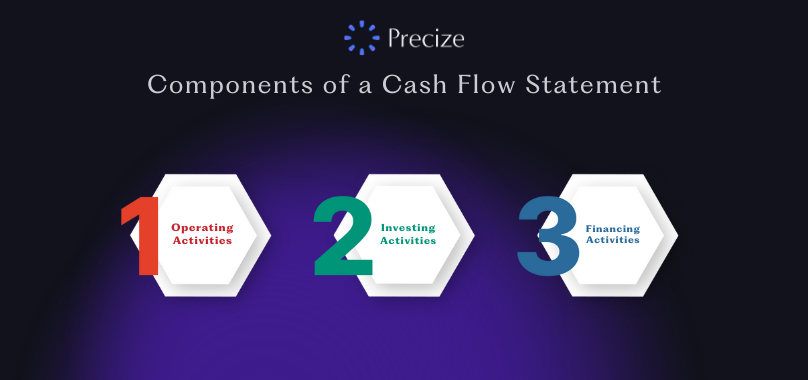
A cash flow statement is divided into three sections, each showing cash movement from different activities:
Operating Activities
This section covers cash generated or spent through the company’s core business activities.
It includes money received from customers, payments made to suppliers, salaries, rent, taxes, and other expenses related to daily operations.
If more cash is coming in than going out, it means the business is generating enough money from its operations.
Investing Activities
This section records cash spent on or received from investments.
It includes money used to buy or sell assets like land, equipment, or shares in other companies.
A business spending money here might be investing in growth, while cash inflows in this section often come from selling assets.
Financing Activities
This section tracks cash movements related to borrowing and repaying loans, issuing shares, or distributing dividends.
If a company takes a loan or raises money from investors, it appears as a cash inflow.
Loan repayments and dividend payments show as cash outflows.
Now that you’re familiar with the cash flow statement and its components, let’s explore the different methods.
Methods of Preparing a Cash Flow Statement
When you prepare a cash flow statement, you have two main methods to choose from: the direct method and the indirect method. Both methods help you understand how cash flows in and out of your business, but the way they present the data is different.
Direct Method
In this method, actual cash transactions are recorded directly under operating activities. It lists cash receipts (such as money received from customers) and cash payments (such as salaries, rent, and supplier payments) to show net cash flow from operations.
For example, if a small business has the following cash transactions in a month:
Cash received from customers: ₹5,00,000
Payments to suppliers: ₹2,00,000
Salaries paid: ₹1,00,000
Rent and other expenses: ₹50,000
Net cash flow from operating activities = ₹5,00,000 - (₹2,00,000 + ₹1,00,000 + ₹50,000) = ₹1,50,000
Indirect Method
The indirect method starts with the net profit from the profit and loss statement and then adjusts it by adding or subtracting non-cash expenses (like depreciation) and changes in working capital (like outstanding payments and receivables).
The indirect method is widely used because most companies prepare their financial statements on an accrual basis, where revenue and expenses are recorded when they occur, not when cash is exchanged.
For example, a company has:
Net profit: ₹4,00,000
Depreciation expense: ₹50,000 (added back because it's a non-cash expense)
Increase in accounts receivable: ₹70,000 (subtracted because it’s money yet to be received)
Increase in accounts payable: ₹40,000 (added because payment is delayed)
Net cash flow from operating activities = ₹4,00,000 + ₹50,000 - ₹70,000 + ₹40,000 = ₹4,20,000
With the preparation methods in place, let's take a closer look at the advantages cash flow statements bring to your financial strategy.
Benefits of Using Cash Flow Statements
A cash flow statement offers several key benefits that help businesses stay on track financially. Here’s why it is important:
Helps Assess Liquidity
The cash flow statement gives a clear view of a business’s liquidity, showing whether it has enough cash to cover its short-term obligations like bills, wages, and loan repayments. This is essential to avoid financial strain, even if the business is profitable on paper.
Tracks Cash Flow Trends
By regularly reviewing cash flow statements, you can spot patterns in cash movement, such as periods of high or low cash inflows. This can help in planning for lean times or identifying opportunities to manage cash better.
Improves Financial Planning
Understanding cash flow helps with better financial planning. It helps you predict future cash needs, plan for upcoming expenses, and avoid running into cash shortages unexpectedly.
Informs Decision-Making
A cash flow statement helps in making informed business decisions. It shows if a business can afford to explore new projects, repay debt, or manage operations smoothly without getting into financial trouble.
Supports Loan and Investment Decisions
Lenders and investors often look at cash flow statements to determine if a business is financially stable enough to pay back loans or generate returns. It provides a clearer picture of financial health beyond profits.
Highlights Cash Management
It helps track how effectively cash is being managed. If a business is spending too much or not collecting payments on time, the cash flow statement will reveal this, allowing management to take corrective action.
Now that you understand the benefits of cash flow statements, let’s discuss the key steps in analyzing them to draw meaningful insights.
5 Steps to Analyze a Cash Flow Statement
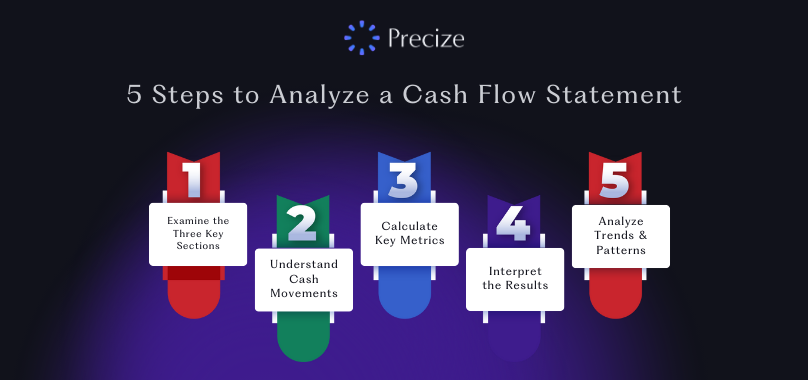
Analyzing a cash flow statement is crucial to understanding your company's financial health. Here are five steps to help you interpret the numbers:
Step 1: Examine the Three Key Sections
Focus on the three main sections of the cash flow statement: cash flow from operations, investing activities, and financing activities.
These sections provide insight into how cash is generated and used in different areas of the business.
Step 2: Understand Cash Movements
Look closely at the cash inflows (money coming in) and outflows (money going out).
Understanding these movements will help you evaluate whether the company is effectively managing its cash flow and if it has sufficient liquidity to cover its obligations.
Step 3: Calculate Key Metrics
Here are two key metrics to consider when:
Net Change in Cash: This metric indicates the overall change in cash over a given period. It’s calculated by summing the net cash flows from the operating, investing, and financing activities.
Free Cash Flow: This figure shows the cash available after accounting for operating expenses and capital expenditures, indicating the company’s ability to invest in growth or pay down debt.
Step 4: Interpret the Results
Here is how you can interpret the results:
Positive Cash Flow: A positive cash flow typically signals that the business is generating more cash than its spending, which is a sign of financial stability.
Negative Cash Flow: A negative cash flow, especially in the operating section, may indicate a need to address liquidity issues or could reflect investment in future growth.
Step 5: Analyze Trends and Patterns
Review cash flow statements over multiple periods to identify trends.
Regular analysis helps highlight recurring cash flow patterns, such as seasonal fluctuations or cash flow shortfalls and provides insight into areas that may require adjustments.
Now that you know how to analyze a cash flow statement, let’s take a look at a practical example to see how it all comes together.
Example of a Cash Flow Statement
To better understand how a cash flow statement works, let’s look at a simple example of a cash flow statement for a business over the course of a month. This example will help clarify how cash flows are tracked in the three main sections:
Cash Flow from Operating Activities
Cash received from customers: ₹5,00,000
Cash paid to suppliers and employees: ₹3,00,000
Cash paid for operating expenses (rent, utilities, etc.): ₹50,000
Net Cash Flow from Operating Activities: ₹5,00,000 (cash received) - ₹3,00,000 (paid to suppliers and employees) - ₹50,000 (operating expenses)
Net Cash Flow from Operating Activities = ₹1,50,000
Cash Flow from Investing Activities
Purchase of new equipment: ₹1,00,000
Sale of an old machine: ₹30,000
Net Cash Flow from Investing Activities: ₹30,000 (from the sale of equipment) - ₹1,00,000 (purchase of new equipment)
Net Cash Flow from Investing Activities = -₹70,000
Cash Flow from Financing Activities
Loan received: ₹2,00,000
Loan repayment: ₹50,000
Net Cash Flow from Financing Activities: ₹2,00,000 (loan received) - ₹50,000 (loan repayment)
Net Cash Flow from Financing Activities = ₹1,50,000
Net Change in Cash
Cash at the beginning of the month: ₹1,00,000
Net Change in Cash From all Three Sections: ₹1,50,000 (Operating) + -₹70,000 (Investing) + ₹1,50,000 (Financing) = ₹2,30,000
Net Change in Cash = ₹2,30,000
Cash at the End of the Month: ₹1,00,000 (beginning balance) + ₹2,30,000 (net change) = ₹3,30,000
With an example in mind, let's move on to understanding the potential limitations of cash flow statements.
Common Limitations of Cash Flow Statements
When analyzing a cash flow statement, it’s important to understand its limitations. Here are some key points to consider:
Incomplete Financial Picture
A cash flow statement alone doesn’t provide a full view of a company’s financial health. To get a more complete understanding, it should be analyzed alongside other financial statements like the balance sheet and income statement.
Excludes Non-Cash Transactions
Cash flow statements focus only on actual cash movements and exclude non-cash transactions such as depreciation, asset revaluations, or the issuance of shares. This means it won’t give you the complete picture of a company’s financial activities.
Does Not Reflect Liquidity Fully
While the cash flow statement tracks cash inflows and outflows, it doesn't accurately show a company’s liquidity. Liquidity also depends on assets that can be quickly converted to cash, which the statement does not reflect.
Does Not Indicate Profitability
Since the cash flow statement is based only on actual cash transactions, it doesn’t include non-cash items like depreciation or amortization. As a result, it doesn’t directly show a company’s profitability.
Historical Data Only
Cash flow statements provide a snapshot of past cash activity, which makes it difficult to predict future financial positions. It doesn’t give insight into future cash flow trends or potential financial challenges.
Lack of Standardization
There is no universal standard for preparing cash flow statements across companies or industries, which can make it harder to compare businesses accurately.
Manipulation Possibilities
Companies may manipulate cash flow figures by delaying payments or accelerating collections. This could distort the true cash position and give an inaccurate picture of the business’s financial health.
Conclusion
As we've discussed, understanding cash flow statements meaning is vital for effective financial planning. It helps you track the movement of cash within a business, assess its liquidity, and evaluate its overall financial health. Whether you're analyzing short-term cash needs or long-term financial stability, the insights provided by a cash flow statement are key to making informed decisions.
If you're seeking alternative investment opportunities in India, Precize offers access to private equity and private credit opportunities. The platform provides detailed research reports, including cash flow statements, balance sheets, income statements, and industry and peer analyses. These resources can help you make well-informed decisions for your investment strategy.
Reserve your access to Precize today and gain the insights to diversify your portfolio!