
Have you ever wondered how businesses keep track of their earnings, expenses, or whether they’re making profits or losses?
Whether running a small shop, managing a company, or planning to explore stocks, understanding financial statements can give you a clear picture of where the money is coming from and going. These statements are like a report card for any business, showing its financial health in a structured way.
In this blog, we will cover the meaning and objectives of financial statements. You’ll learn about the key types of financial statements, such as the balance sheet, income statement, and cash flow statement, and how to read them.
We will also explain who uses these statements, from investors to lenders. By the end, you will understand the importance of financial statements PDF and their role in assessing a company’s financial health.
Let’s get started!
What Exactly are Financial Statements?
Financial statements are important documents that provide a clear picture of a company's financial health. They summarize an organization's financial activities over a specific period, helping you understand how the business is performing.
Understanding financial statements is just the start—let's explore their main objectives.
Key Objectives of Financial Statements

Financial statements serve as a critical tool for understanding and evaluating the financial health of a business. They are prepared with specific objectives to meet the needs of various stakeholders, ensuring transparency and informed decision-making. Here are the key objectives:
Provide Relevant Financial Information
Financial statements present accurate and relevant data about a company's financial position, performance, and cash flows. This information enables stakeholders, including investors, creditors, and management, to make informed decisions about resource allocation.
For instance, understanding revenue trends during a specific period can help gauge the company’s financial standing.
Support Performance Evaluation
These statements are essential for assessing a company's performance over time. By analyzing key metrics such as revenues, expenses, and net income, stakeholders can identify trends and evaluate management's operational effectiveness.
For example, consistent profit growth over multiple periods may indicate operational efficiency and sound business practices.
Facilitate Comparability
Financial statements are prepared following standardized accounting principles, which enable comparisons across different reporting periods and with other companies in the same industry. This comparability is crucial for benchmarking performance and identifying strengths or weaknesses.
For instance, stakeholders can use financial ratios to compare a company's performance against industry averages.
Aid in Compliance and Accountability
Financial statements ensure companies adhere to legal and regulatory requirements. They promote accountability by providing a transparent view of financial operations and helping stakeholders understand how resources are managed.
Regulatory bodies often require businesses to submit these statements to maintain compliance with financial laws and ethical standards.
Evaluate Profitability
Financial statements detail a company’s income and expenses, offering insights into profitability. This analysis helps stakeholders understand the company’s ability to generate returns relative to its operations.
For instance, metrics like gross profit margin highlight how well the company manages its costs in terms of revenue generation.
Assess Solvency and Creditworthiness
Stakeholders use financial statements to evaluate a company's ability to meet short-term obligations (solvency) and its overall creditworthiness. This assessment is especially important for lenders and suppliers. Ratios like the current or debt-to-equity ratio offer valuable insights into financial stability and the company’s capacity to handle liabilities.
Inform Stakeholders of Financial Health
Financial statements provide a comprehensive view of a company’s assets, liabilities, and equity. This overview is crucial for understanding the organization's financial position and overall stability.
For instance, a balance sheet highlighting high liabilities relative to assets may indicate potential financial challenges.
Armed with an understanding of their objectives, let’s shift gears and explore the main types of financial statements and how to read them effectively.
Types of Financial Statements & How to Read Them
Understanding financial statements is essential because each statement provides unique insights into various aspects of a business. Here are the main types of financial statements and how to interpret them effectively.
Balance Sheet
The balance sheet provides a snapshot of a company’s financial position at a specific time. It is divided into three key components: assets, liabilities, and equity.
Assets: These are what the company owns. Assets are categorized as current assets (e.g., cash, accounts receivable, inventory) and non-current assets (e.g., property, equipment).
Liabilities: These represent what the company owes, including current liabilities (short-term obligations like accounts payable) and long-term liabilities (e.g., loans, bonds).
Equity: This is the residual interest in the company after deducting liabilities from assets. It includes retained earnings and shareholder contributions.
The equation governs the balance sheet:
Assets = Liabilities + Shareholders’ Equity
Here is How to Read the Balance Sheet:
Compare total assets with total liabilities to assess financial stability.
Analyze the equity section to understand the mix of shareholder investment versus debt financing.
Look for changes in key metrics over multiple periods to identify trends in financial health.
Income Statement
The income statement, also known as the profit and loss statement, summarizes the company’s revenues, expenses, and net income over a specific period.
Revenue: Total earnings from sales of goods or services.
Expenses: Costs incurred to generate revenue, including operating expenses (e.g., salaries, rent) and Cost of Goods Sold (COGS).
Net Income: The profit after all expenses have been deducted from revenue. Often referred to as the "bottom line."
Here is How to Read the Income Statement:
Analyze revenue trends over multiple periods to assess growth potential.
Subtract COGS from revenue to calculate gross profit, then evaluate operating income by deducting operating expenses.
Review net income to determine overall profitability and efficiency.
Cash Flow Statement
The cash flow statement tracks cash inflows and outflows over a period, divided into three sections:
Operating Activities: Cash generated from core business operations.
Investing Activities: Cash used for purchasing or selling long-term assets.
Financing Activities: Cash flows related to borrowing, debt repayment, and equity transactions.
Here is How to Read the Cash Flow Statement:
Start by analyzing cash flow from operating activities to gauge operational efficiency.
Review investing activities to understand the company's growth strategy or asset utilization.
Examine financing activities to assess how the company manages its capital structure.
Statement of Changes in Equity
This statement outlines movements in equity over a specific period, detailing:
Opening balance of equity.
Additions from shareholder investments or new stock issuances.
Impact of net income from the income statement.
Dividends paid to shareholders.
Closing equity balance.
Here is How to Read the Statement of Changes in Equity:
Observe how profits (net income) affect retained earnings.
Review dividends to see how much profit is distributed versus reinvested.
Look for equity changes due to investments or share buybacks.
Comprehensive Income Statement
This expands the traditional income statement by including all equity changes unrelated to shareholder transactions.
Net Income: Carried over from the income statement.
Other Comprehensive Income (OCI): Includes unrealized gains/losses, foreign currency adjustments, and pension plan revaluations.
Here is How to Read the Comprehensive Income Statement:
Start with net income to understand operational profitability.
Review OCI items to identify external factors impacting financial performance.
Evaluate total comprehensive income for a holistic view of financial outcomes.
Notes to Financial Statements
These notes provide essential details about the figures presented in the financial statements. They cover:
Accounting policies and methods used.
Detailed breakdowns of significant line items.
Information about risks, contingencies, and legal matters.
Here is How to Read Notes on Financial Statements:
Focus on accounting policies to understand the basis for reported figures.
Review explanations of key items to clarify complex entries.
Check for disclosed risks or uncertainties that could affect future performance.
Key Ratios and Trends
After analyzing each statement, calculate financial ratios for deeper insights:
Liquidity Ratios: For example, the current ratio (Current assets / current liabilities) assesses the ability to meet short-term obligations.
Profitability Ratios: For example, the Net Profit Margin (Net Income / Revenue) is used to measure profit efficiency.
Leverage Ratios: The Debt-to-Equity Ratio (Total Liabilities / Shareholders’ Equity) evaluates the balance between debt and equity financing.
With the types and reading tips covered, it’s time to look at the people who depend on these documents. Who are they?
Users of Financial Statements
Financial statements offer a wealth of information about a company's financial health, serving as critical resources for diverse stakeholders. Here is a table summarizing who uses financial statements and why:
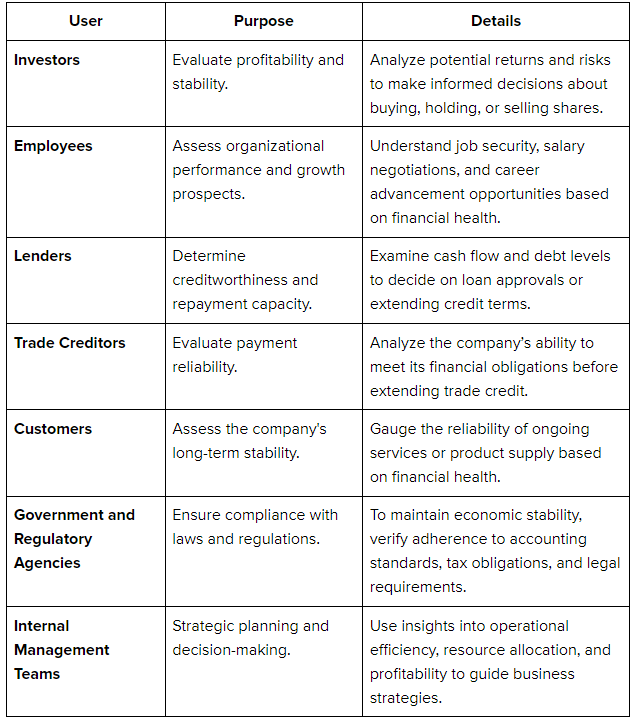
Having identified the users, it’s time to discuss what makes financial statements crucial.
Importance of Financial Statements

Financial statements are vital for assessing a company's financial well-being. They serve as a reliable source of information, enabling business owners and investors to make strategic decisions confidently. Here are the key reasons financial statements are indispensable.
Informed Decision-Making
Financial statements serve as a foundation for making well-informed and strategic decisions. They provide detailed insights into a company’s revenues, expenses, and profitability.
For instance, reviewing an income statement can help you assess whether the business generates enough profit to allocate resources for growth or other needs. These insights ensure that decisions are grounded in accurate data rather than assumptions.
Performance Assessment
With financial statements, you can evaluate a company’s performance over time by tracking trends in key metrics like revenues and expenses. They help you identify what’s working and what needs improvement.
For example, expenses growing faster than revenue may signal the need for cost-control measures or operational adjustments. Regular analysis helps set realistic goals and monitor progress effectively.
Credibility with Lenders
Financial statements are critical when seeking loans or credit from financial institutions. Lenders review these documents to determine the company’s creditworthiness and loan repayment capacity.
A strong financial position reflected in these statements can increase the likelihood of securing funding for business expansion or other projects.
Regulatory Compliance
Preparing and maintaining financial statements is a legal requirement in India and many other countries.
These statements ensure compliance with tax laws, industry regulations, and other statutory requirements, avoiding penalties or legal complications. By adhering to regulatory standards, businesses demonstrate accountability and transparency.
Benchmarking
Financial statements enable you to compare your business’s performance with industry standards or competitors. This benchmarking process highlights strengths and areas for improvement.
For instance, if your company’s profit margins are below the industry average, it may indicate a need to refine pricing strategies or improve operational efficiency.
Strategic Planning
Management teams rely on financial statements for strategic planning. By analyzing the company’s financial position, they can make informed decisions about resource allocation, investments, or scaling back certain activities. These insights ensure the business remains competitive and adapts to changing market conditions effectively.
Conclusion
The importance of financial statements PDF cannot be overstated when making informed decisions in business and investments. These statements clearly understand a company’s financial health, enabling you to evaluate profitability, liquidity, and operational performance effectively.
Regular analysis helps identify trends, uncover growth opportunities, and address areas needing improvement, empowering you to make smarter choices.
To take your financial knowledge further and explore diverse investment opportunities, consider reserving access to Precize. This platform lets you diversify your portfolio with private equity and credit.