



You’ve likely been hearing more success stories around wealth creation through the Indian stock market, and it’s no coincidence. With growing investor confidence, the National Stock Exchange (NSE) has become a key platform for serious market participants like you looking to build and manage large-scale investments.
In fact, by the end of FY25, the NSE recorded a 6.94% rise in the total market capitalization of listed companies, touching Rs 530000 lakh crore (approximately $5.3 trillion). This steady growth reflects both the depth of the Indian equity market and the increasing trust of institutional and high-net-worth investors.
In this blog, you’ll learn how to invest in NSE and why it’s a preferred platform for serious investors. We’ll explain what NSE is, how it works, and walk you through a simple process to start investing. You’ll also explore key investment options, understand common mistakes to avoid, and get insights tailored to help you grow and manage large portfolios effectively.
To start, let’s understand the basics!
Quick Summary
NSE is India’s leading electronic stock exchange offering transparent and fast trading across various segments like stocks, ETFs, and derivatives.
It works through a fully automated system, matching buy and sell orders based on price-time priority and ensuring fair execution.
NSE stands out for its strong technology, wide range of investment options, market transparency, and nationwide access.
Starting is easy with platforms like Precize, where you can create an account, complete KYC, link your demat account, and begin trading NSE-listed shares securely.
What is NSE?
The NSE is one of India’s leading stock exchanges where investors can buy and sell shares, bonds, ETFs, and other financial instruments. Launched on November 3, 1994, NSE was the first fully electronic exchange in India, offering a fast and transparent trading system. It operates under the regulation of SEBI (Securities and Exchange Board of India) and is known for its secure and efficient platform.
The NSE uses advanced technology to match buyers and sellers in real time through an automated trading system.
It also provides a benchmark index called the Nifty 50, which tracks the performance of 50 of the largest and most liquid companies listed on the exchange.
Today, NSE plays a major role in India’s financial system by offering a trusted platform for trading and investment across different sectors.
Now that you know what NSE is, let’s take a quick look at the current price of its unlisted shares in the private market.
NSE Unlisted Share Price
As of 1 August 2025, the unlisted share price of NSE stands as follows:
Face Value: ₹1.00
Price per Share: ₹2,169.00
Price per Lot (5 shares): ₹10,845.00
[Source: Financial Reports]
[These prices are based on the latest data available from private market platforms where NSE unlisted shares are traded. Keep in mind that unlisted share prices are subject to change based on market demand, company performance, and investor interest. Always verify the latest price and related details through trusted platforms like Precize before making any decisions related to how to invest in NSE or unlisted shares.]
Before going any further, it helps to know how the NSE operates.
How does the NSE work?
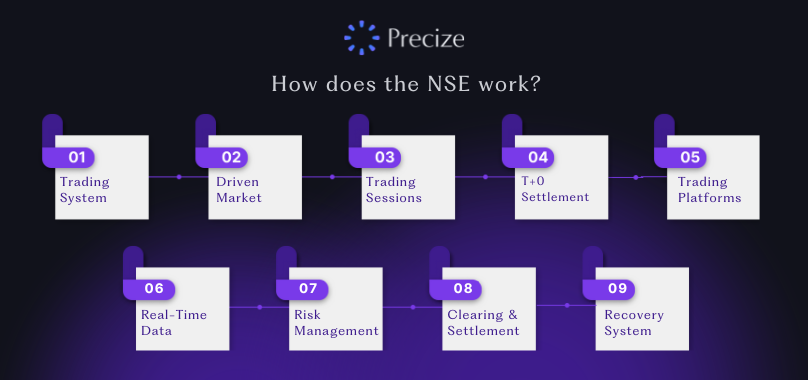
The NSE runs a highly advanced, fully digital system that handles trading across India in a fast, safe, and transparent way. Here is how it works:
1. Electronic Trading System (NEAT)
NSE uses a fully automated screen-based system called NEAT (National Exchange for Automated Trading), which connects 219,015 trading terminals across India as of March 31, 2025, to carry out trades quickly and smoothly.
2. Order-Driven Market
All trades are matched automatically by computers based on price and time. This ensures fair and efficient trade execution without manual involvement.
3. Trading Sessions
The trading day is divided into different sessions: pre-open (for collecting orders before the market opens), regular trading hours, and special blocks like auction and block deal windows.
4. T+1 and T+0 Settlement
Most trades follow the T+1 cycle, meaning transactions are settled one working day after the trade. For select participants, NSE also offers T+0 settlement, allowing same-day settlement.
5. Trading Platforms & Tools
In addition to NEAT, NSE provides NEAT Plus for multi-market trading. Traders can also use third-party software, direct market access, and tools like algorithmic trading and smart order routing.
6. Real-Time Data & Transparency
Live updates on trades and order book data are shared instantly with members, helping maintain a transparent and trustworthy market environment.
7. Risk Management & Surveillance
NSE monitors all trading activities closely to prevent fraud, market abuse, or manipulation, ensuring a fair and safe trading space.
8. Clearing & Settlement
Once trades are confirmed, NSE Clearing Limited handles the settlement of shares and funds securely between buyers and sellers.
9. Disaster Recovery System
NSE has a backup recovery site and regular testing processes to keep the market running smoothly, even in the case of a system failure.
After understanding the core structure and technology behind NSE, it’s important to know what sets it apart as a reliable trading platform.
Why Choose NSE for Stock Market Investment?
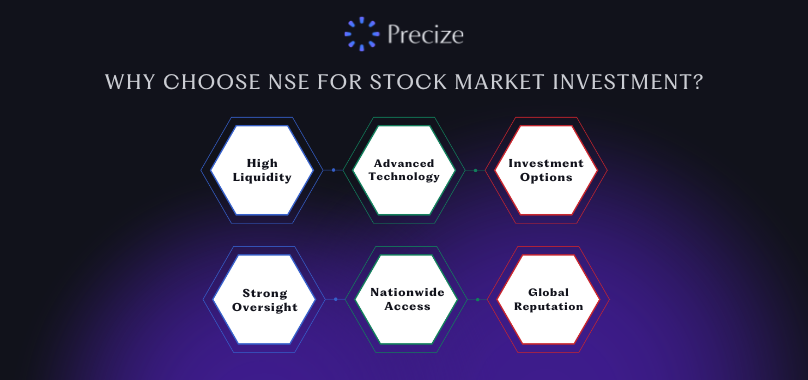
When exploring options in the Indian stock market, the NSE is often a preferred choice, and for good reason. Here’s what makes NSE stand out, especially in 2025:
High Liquidity: With a large number of people actively buying and selling, it's easier to place trades quickly. This also helps keep prices fair and stable.
Advanced Technology: NSE runs on a fast, fully electronic system that handles trades smoothly and securely. No matter where you’re located, your transactions happen in real time with complete transparency.
Multiple Investment Options: NSE gives access to a wide variety of financial instruments like stocks, bonds, ETFs, and derivatives, all available on a single platform.
Strong Oversight: The exchange operates under the strict watch of India’s financial regulators, which adds an extra layer of security and builds confidence among market participants.
Nationwide Access: Whether you're in a metro city or a smaller town, NSE allows you to trade easily through your broker’s online platforms.
Global Reputation: NSE is not only India’s largest stock exchange but also one of the biggest in the world. Its modern infrastructure and reliable systems have made it a trusted platform for many over the years.
Now that you know why NSE is a preferred platform, let’s break down how you can get started with it, step by step.
Simple Process to Start Investing in NSE
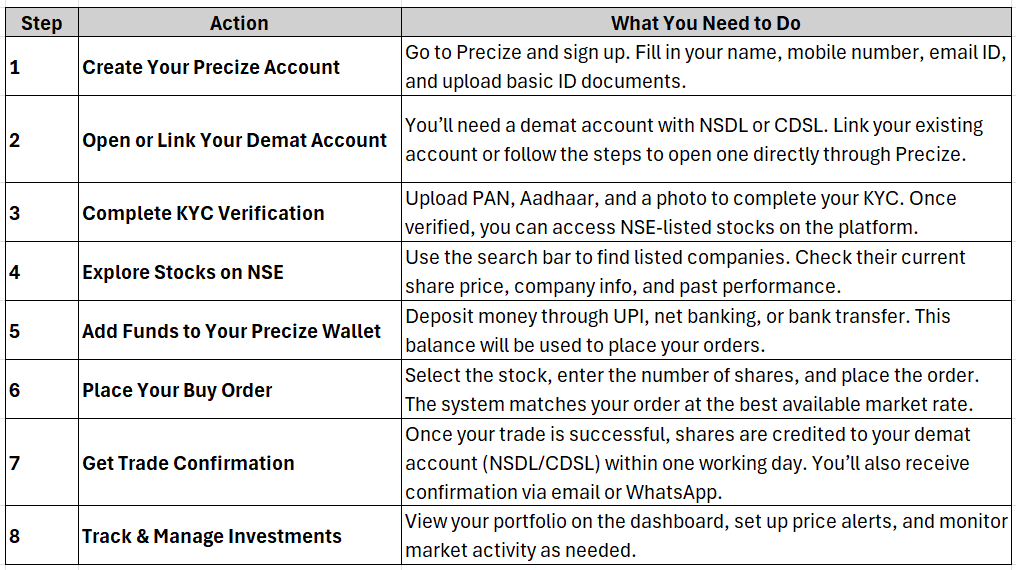
Starting your journey with the NSE is straightforward, especially when using online platforms like Precize, which make the entire process easy, safe, and hassle-free. The table below explains each step clearly.
Popular Investment Options Available on NSE
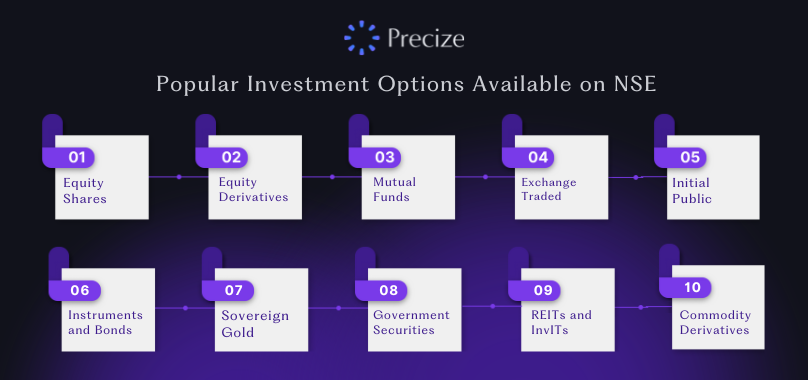
When you explore investment opportunities through the NSE, you’ll come across a variety of choices suited for different goals, risk levels, and preferences. Here are the most commonly traded options on NSE:
1. Equity Shares (Stocks)
You can buy and sell shares of companies listed on the NSE. Owning these shares means you hold a part of the company and may benefit from price movements and dividends.
2. Equity Derivatives
This includes futures and options based on individual stocks or stock indices. These tools are used to manage risk or take positions based on expected price changes.
3. Mutual Funds
NSE offers various mutual fund schemes, equity, debt, and hybrid types, where your money is professionally managed. You can invest in small amounts with ease.
4. Exchange Traded Funds (ETFs)
ETFs are funds that trade like shares on the exchange. They typically follow an index, a commodity like gold, or other assets. ETFs blend features of both stocks and mutual funds.
5. Initial Public Offerings (IPOs)
NSE allows participation in IPOs, where companies offer their shares to the public for the first time. Once allotted, these shares are listed and can be traded on the exchange.
6. Debt Instruments and Bonds
NSE lists government and corporate bonds, which may suit those who prefer steady interest income with relatively lower risk.
7. Sovereign Gold Bonds (SGBs)
These are gold-linked bonds issued by the Indian government. They let you invest in gold without needing to store it physically.
8. Government Securities (G-Secs)
These include treasury bills and long-term bonds issued by the central government. They are often considered low-risk investments.
9. REITs and InvITs
Real Estate Investment Trusts (REITs) and Infrastructure Investment Trusts (InvITs) are available for trading on NSE, giving access to the real estate and infrastructure sectors through the stock market.
10. Currency and Commodity Derivatives
NSE also provides a platform to trade in currency pairs and commodity-linked contracts for those interested in these segments.
Before taking your next step, it’s helpful to be aware of the common errors many new investors face on NSE.
Common Mistakes to Avoid While Exploring NSE
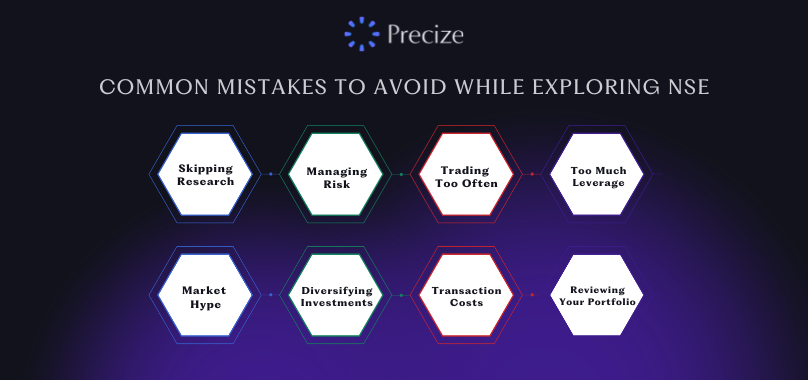
As you begin to explore the NSE, it’s important to be aware of a few common mistakes that many people make, especially in the early stages. Understanding these can help you avoid confusion and make better choices while navigating the stock market:
1. Skipping Research and Planning
Jumping into trades without knowing how the market works or learning about specific companies can lead to poor decisions.
It’s important to take time to understand NSE and check company details before making any move.
2. Not Managing Risk
Many investors overlook risk management. Tools like stop-loss orders can help protect you from unexpected losses.
Also, putting all your money into one company or sector increases risk, so it’s better to spread it out.
3. Trading Too Often
Frequent trading can add up in costs and lead to impulsive actions. Try to avoid trading based on trends or tips unless you have a clear reason and strategy in place.
4. Using Too Much Leverage
Borrowing money to trade can lead to higher profits, but also bigger losses. Use leverage only if you understand how it works and are prepared for the risks involved.
5. Following Market Hype
Making decisions just because others are doing the same can be risky.
Avoid relying only on tips or popular trends.
Focus on your own research and understanding before acting.
6. Not Diversifying Investments
Putting all your money into one stock or industry can increase your risk. A better approach is to divide your money across different companies and sectors.
7. Ignoring Transaction Costs
Brokerage fees, taxes, and other charges may seem small, but they can affect your overall returns. Always check and compare costs before using any trading platform.
8. Not Reviewing Your Portfolio
Once you start trading, it’s important to check in regularly. Review how your investments are performing and adjust based on your financial goals and market changes.
Conclusion
Understanding how to invest in NSE gives you a solid starting point to explore the Indian stock market with confidence. From knowing what the National Stock Exchange is, how it functions, to the simple steps involved in getting started, each part of the process plays a role in helping you make informed decisions. Today, platforms like Precize make this journey even easier by offering secure access to NSE-listed stocks along with other unique investment opportunities.
Precize not only simplifies the process of buying and selling unlisted shares, but also gives you access to unlisted and pre-IPO shares in India’s private companies. It also opens doors to global trade finance opportunities, helping you explore alternative fixed-income options and diversify your investment portfolio beyond traditional routes.
Ready to explore more? Reserve your access on Precize and take the first step toward a seamless and secure investment experience.
Frequently Asked Questions (FAQs)
1. Is it Safe to invest in NSE?
Yes, investing through the NSE is considered safe from a regulatory and operational point of view. It is governed by SEBI, which ensures fairness and investor protection. However, like all market investments, it carries risks due to price movements and market volatility. Staying informed and knowing your risk capacity is important.
2. Can I Invest in NSE Without a Broker?
Yes, you can invest without a traditional broker by opening a Demat account with a registered Depository Participant (DP) like a bank or financial platform. This lets you buy and hold shares directly in electronic form through a secure and regulated process.
3. How Much Money Do I Need to Start Investing?
You don’t need a large amount to begin. You can start with as little as the price of a single share, sometimes ₹100 or less. While small charges like brokerage may apply, many investors begin with ₹100–₹500 based on comfort and goals.
4. Which Stocks Are Best for Beginners?
Beginners often look at stable, well-known companies with strong track records. As of 2025, popular choices include Tata Motors, ONGC, Bharat Electronics, and HDFC Bank, commonly known as blue-chip stocks.
Disclaimer
The information provided in this blog is for general awareness and educational purposes only. It should not be considered financial advice, investment guidance, or a recommendation to buy, sell, or hold any financial products or securities. Always do your own research or consult a registered financial advisor before making any investment decisions.