Are you thinking of launching your own company in India? In India, companies have various legal structures. The Companies Act 2013 classifies them based on several criteria, including the number of members, size, liability, control, capital access, and ownership.
Different Types of Companies in India
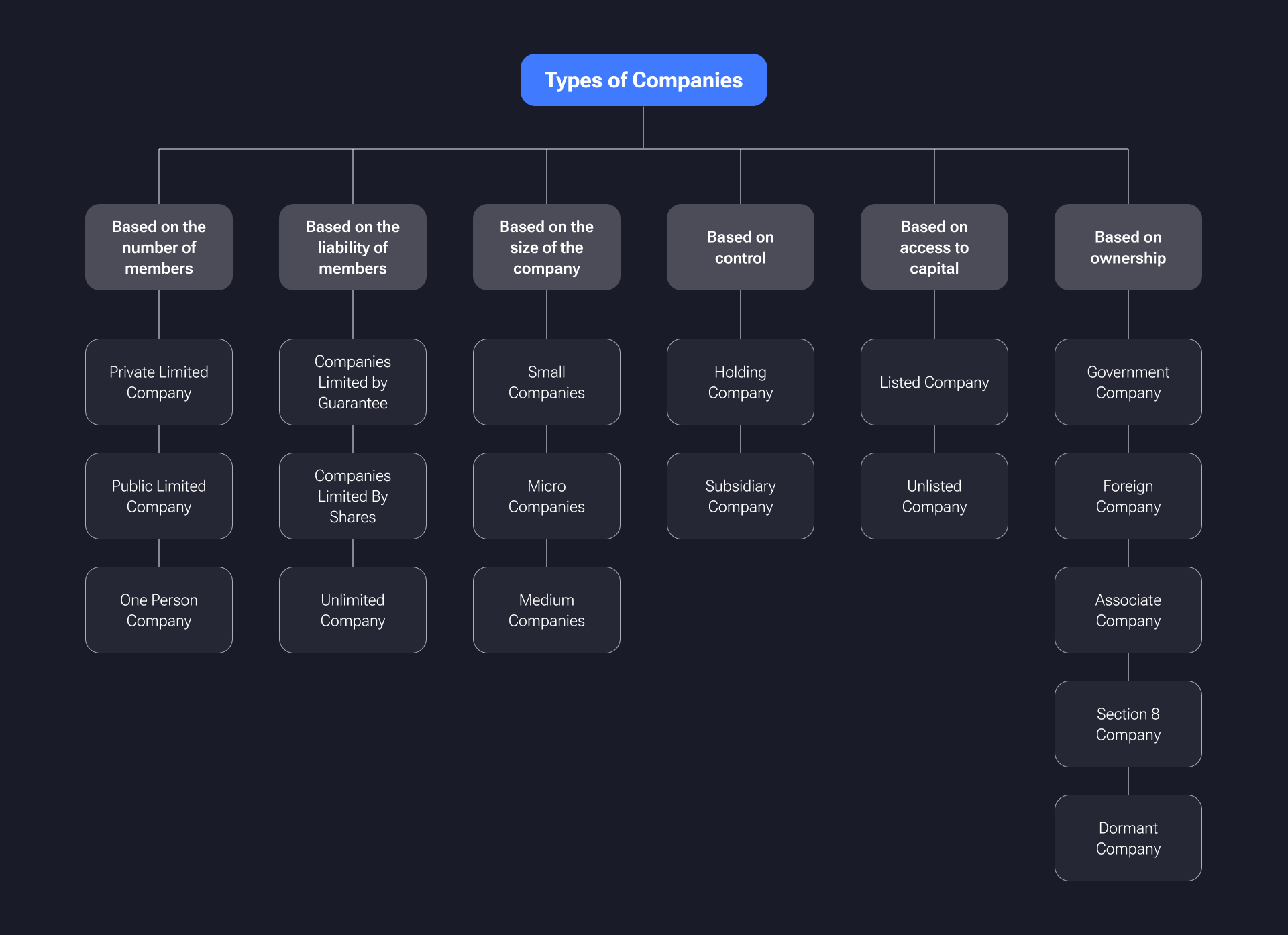
Overview of various types of companies in India:
Private Limited Company: In India, a private limited company is a privately owned business entity with limited liability. This type of company can have up to 200 shareholders. The shares of a private limited company cannot be traded or transferred publicly.
Public Limited Company: In this type of company, the general public holds shares, which can be easily traded since it is listed on the stock exchange. While there is no limit on the number of shareholders, a minimum of 7 members is required to form this company.
One Person Company(OPC): A One Person Company (OPC) has only one shareholder, who may also serve as the director. OPCs maintain full control over operations and do not require any minimum share capital, making them ideal for small businesses that want to limit liability.
Companies Limited by Guarantee: Companies Limited by Guarantee, also referred to as Guarantee Companies, have members who agree to contribute a specified amount to the company's assets in the event of its closure. This commitment limits their financial liability. The amount each member pledges determines their ownership stake in the company.
Companies Limited By Shares: In these companies, the Memorandum of Association (MOA) limits the liability of its members. The liability of the company’s shareholders is limited to the nominal value of their shares. These companies issue shares through an Initial Public Offering (IPO). A shareholder's ownership in the company is defined by the equity shares they hold.
Unlimited Company: It is a type of private company where there is no limit on the liability of its members. This company may or may not have share capital. If the company experiences a sudden increase in debt, the liability of the members grows and may extend to their personal assets.
Small Companies: A small company is defined as one with an investment in plant and machinery under ₹10 crore and an annual turnover that does not exceed ₹50 crore. According to the Companies Act, 2013, a company with paid-up share capital below ₹4 crore and an annual turnover below ₹40 crore is classified as a small company, which entitles it to various benefits.
Micro Companies: Micro companies are those with investments in plant and machinery not exceeding ₹1 crore and an annual turnover not surpassing ₹5 crore.
Medium Companies: Medium companies have investments in plant and machinery up to ₹50 crore and an annual turnover not exceeding ₹250 crore.
Holding Company: This company is a business entity that owns one or more other companies referred to as subsidiaries. It acts like a parent company and typically owns more than half of the shares or controls the board of directors of the subsidiary.
Subsidiary Company: A subsidiary company is owned and managed by another company, called the parent or holding company. The parent can be the sole owner or one of several owners. If the parent company fully owns the subsidiary, it is known as a wholly-owned subsidiary.
Listed Company: A listed company is a type of public company whose shares are listed on a stock exchange and traded publicly.
Unlisted Company: Unlisted companies are privately owned and not listed on the stock market. Their shares are referred to as unlisted shares.These companies cannot raise funds from the public and typically trade shares over the counter or through platforms like Precize, Unlistedzone, and Stockify, which facilitate the buying as well as selling of these shares.
Government Company: A government company is one where the central or state government, or both, hold more than 50% of the share capital.
Foreign Company: Foreign companies are those incorporated outside India that conduct business within India, either independently or through partnerships with other companies.
Associate Company: An associate company is a business where another company holds significant influence, typically by owning at least 20% of its shares. A joint venture can also be classified as an associate company.
Section 8 Company: Section 8 Companies, as defined in the Companies Act, 2013, are entities focused on benefiting society by promoting activities such as commerce, art, science, education, charity, and environmental protection. Often referred to as non-profit organizations, their main objective is to serve the community rather than generate profits for their members.
Dormant Company: A dormant company is one that has not conducted any business activity for a period of two consecutive financial years. While it remains registered, it is inactive, possibly waiting to resume operations or temporarily pausing. Dormant companies must still meet certain obligations, such as maintaining a minimum number of directors and filing specific documents.
Conclusion
Understanding the different types of companies in India is crucial for anyone interested in starting a business. Each type offers unique advantages and disadvantages, and classifications based on membership, liability, size, control, access to capital, and ownership can help effectively structure a business.
To support your investment journey, Precize offers a selection of leading private growth companies and global trade finance opportunities. For those looking to invest in unlisted shares, visit Precize.