
You’ve probably heard a lot about the stock market and wondered whether it’s something you should invest in. Maybe you’ve seen stories of people making huge gains or facing big losses, leaving you with more questions than clarity about whether it’s the right move for you.
You’re not alone. The stock market can feel like a complex maze, but it remains one of the most effective ways to grow wealth over time. Historically, the Indian stock market has delivered impressive returns.
The Nifty 50 and BSE Sensex, two major indices that track the performance of India's top companies, have grown significantly over the years, offering long-term investors attractive returns.
If you’re ready to invest in the stock market, this blog will explain everything you want to know about stock market investing. We’ll cover stock market investing, how it works, and what you need to know before starting.
Plus, you’ll learn about investment strategies, how to begin, and the risks involved. We’ll also explain how technical and financial analysis work and how long-term investing can grow wealth. By the end, you’ll be ready to start investing with confidence.
What is Stock Market Investing?
Stock market investing is when you buy shares in a company. When you purchase these shares, you become a part-owner of that company. As the company grows and does well, the value of your shares may increase, which can lead to profits.
On the other hand, if the company performs poorly, the value of your shares could decrease. People invest in the stock market to grow their money over time, as stocks have historically offered higher returns than other investments. By owning stocks, you can benefit from the company’s success.
Now, let’s take a closer look at the main parts of the stock market.
Basic Components of the Stock Market
When you start learning about the stock market, it’s important to understand the key parts that make it work. Everything you wanted to know about stock market investing starts with these main components you should get familiar with:

With the basics covered, let’s move on to some strategies to guide your investment decisions in the stock market.
Investment Strategies in the Stock Market
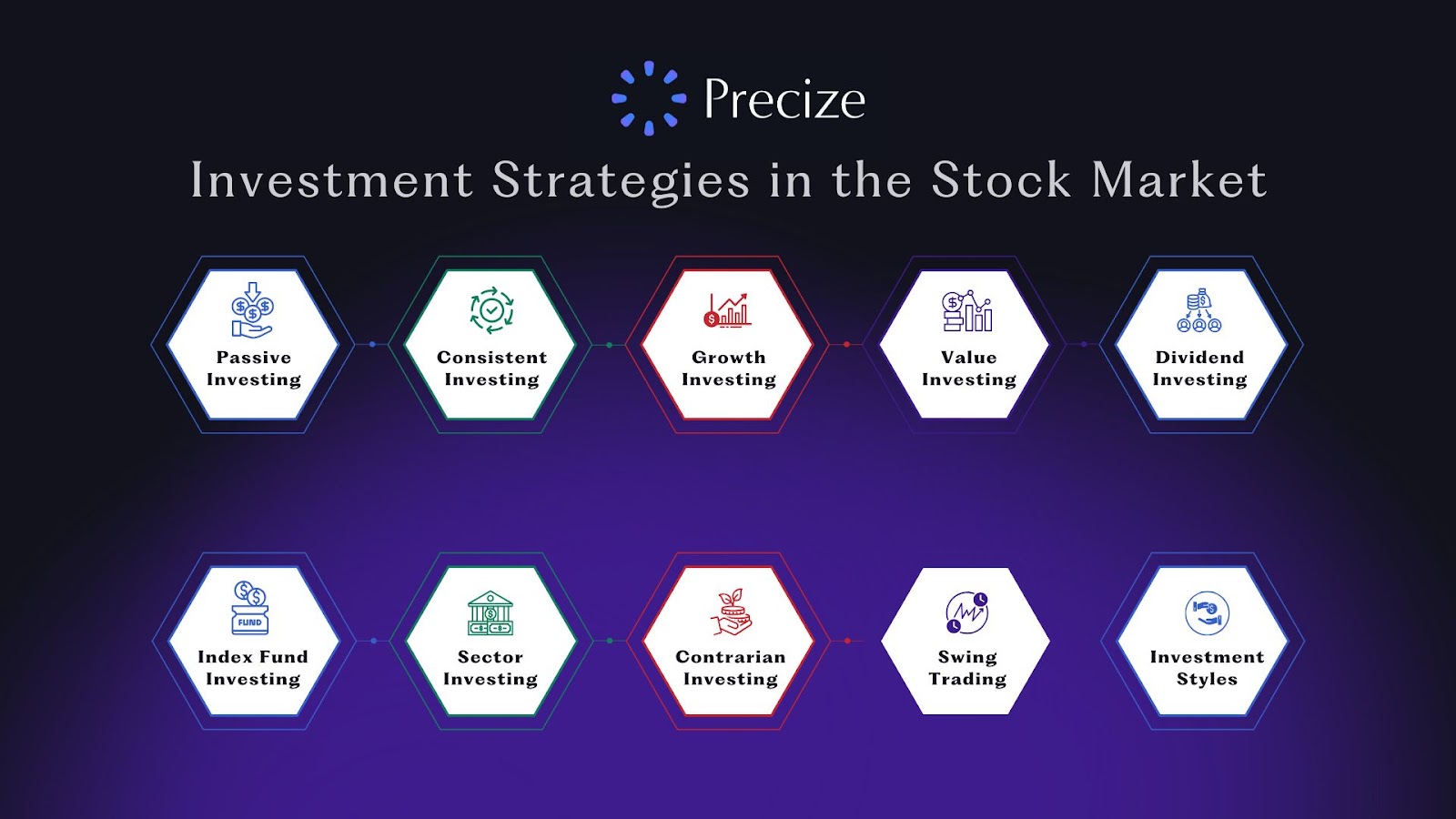
A solid strategy is key to building wealth and achieving financial goals when investing in the stock market. Here are some popular and effective investment strategies to consider, along with real-life examples to help you understand them better:
Buy and Hold Strategy
The “buy and hold” strategy involves purchasing and holding stocks long-term, ignoring short-term market changes. The goal is to benefit from the market’s long-term growth. Even between 1926 and 2010, a $1 investment in large-cap stocks grew to $2,982, while small-cap stocks grew to $16,055, showing the potential for significant returns over time.
Example:
If you had invested in companies like Reliance Industries, HDFC Bank, or Tata Consultancy Services (TCS) 10 years ago and held onto your shares, you would have seen significant growth. These stocks have experienced tremendous price increases, proving that a long-term buy-and-hold approach can deliver substantial returns.
Dollar-Cost Averaging
Dollar-cost averaging means investing a fixed amount of money at regular intervals, regardless of the stock price. This helps reduce the risk of buying stocks with too high prices.
With dollar-cost averaging in the Indian stock market, suppose you invest ₹10,000 every month in the Nifty 50 Index. In January, when the index is 18,000, you buy 0.5556 units. In February, when it drops to 17,500, you buy 0.5714 units. In March, when it rises to 19,000, you buy 0.5263 units. Over these three months, your total investment amounts to ₹30,000, and you accumulate a total of 1.6533 units.
This results in an average cost per unit of approximately ₹18,155.09. By investing the same amount each month, you benefit from market fluctuations, buying more units when prices are lower and fewer when they are higher, thereby averaging your cost and reducing the impact of market volatility.
Growth Investing
Growth investing focuses on stocks from companies expected to grow above average. These companies may not pay dividends but reinvest their profits into expanding their business.
Tesla is a prime example of a growth stock. While it didn’t pay dividends for years, its stock price soared as the company rapidly expanded and became a leader in electric vehicles. Investors who bought Tesla early saw massive returns as the company’s value grew.
Value Investing
Value investing is buying stocks that are undervalued compared to their true worth. The goal is to find stocks selling for less than their intrinsic value and wait for the market to recognize their potential.
A good example of this in the Indian stock market is Tata Motors Ltd. Tata Motors has faced challenges like fluctuating demand and supply chain issues, which have sometimes caused its stock price to drop.
However, the company has strong fundamentals, including a solid product lineup and a significant market share in passenger and commercial vehicles. Investors who recognized this potential during downturns could benefit from future price appreciation as the company recovers and grows,
Dividend Investing
Dividend investing involves purchasing stocks that pay regular dividends. This strategy is great if you seek a steady income stream, especially during retirement.
Example:
Investors who bought shares of Hindustan Unilever Limited HUL over the years have seen stock price appreciation alongside regular dividend payouts. Recently, HUL has maintained a high payout ratio, reported at around 91.62% for the financial year 2024, which indicates that a significant portion of its profits is distributed to shareholders as dividends.
Index Fund Investing
Investing in index funds in the Indian stock market is a straightforward way to grow your money. Instead of picking individual stocks, you invest in a fund that aims to mirror the performance of a popular market index, like the Nifty 50.
For example, you could invest in a fund like the UTI Nifty 50 Index Fund, which invests in the same stocks as the Nifty 50 Index in the same proportions.
When the overall market grows, the value of your investment in the fund grows, too. The beauty of this approach is that you don’t need to worry about choosing the right stocks.
Sector Investing
Sector investing involves focusing on specific industries or sectors you believe will outperform others. By targeting high-growth sectors, you aim to capture the gains from those industries' expansion.
During India's tech boom, many investors turned their attention to the growing technology sector, buying stocks of companies like Infosys, TCS, and Wipro. As the Indian technology industry expanded, these investments saw significant gains, driven by the increasing demand for IT services, software solutions, and global outsourcing.
If you believe in the future of renewable energy, you might invest in the clean energy sector, which could offer high growth potential as demand for green technologies increases.
Contrarian Investing
Contrarian investing involves going against the crowd. You buy when others are selling or sell when others are buying, based on the belief that the market overreacts to short-term news.
In 2008, when the financial crisis led to a steep decline in stock prices, contrarian investors saw an opportunity.
Swing Trading
Swing trading involves holding stocks for a short to medium term, typically days or weeks, to capitalize on price swings. This strategy requires market timing and technical analysis.
If you are a swing trader, you can buy a stock when technical indicators suggest it’s about to rise and sell it once the price has increased. For instance, if a stock like Reliance Industries tends to rise after earnings reports, a swing trader in India might buy before the earnings announcement and sell once the price jumps after the report.
Active vs. Passive Investing
Active investing requires constant monitoring of the market and making adjustments to your portfolio based on market conditions. Passive investing is more hands-off and involves long-term strategies like index fund investing.
If you prefer to be hands-on with your investments, active investing might be for you. You could analyze individual stocks and make trades based on short-term market movements.
On the other hand, passive investing, like investing in an Exchange-Traded Fund (ETF) that tracks the entire market, is a great option for long-term growth if you want to avoid managing your investments actively.
Now that you know the strategies, let’s jump into how you can start investing in stocks.
How to Start Investing in Stocks
Are you thinking about investing in stocks but not sure where to start? Here are easy-to-understand steps to help you get started!
Step 1: Set Your Financial Goals
Before thinking about buying stocks, ask yourself what you’re investing for. Are you saving for retirement in 30 years? Or maybe you’re saving for a down payment on a house in 5 years? Your goals will help shape how you invest.
Example:
Long-term: If you’re investing for retirement, you can afford to take more risks with stocks because you have decades for the market to go up and down.
Short-term: If you’re saving for a house, you might want to focus on safer investments, like bonds or low-risk funds, because you need that money sooner.
The key is understanding what you’re investing for and how long you can afford to let your money grow.
Step 2: Create an Emergency Fund
Before diving into the stock market, have a rainy-day fund. This stash of cash can cover 3-6 months of living expenses in case life throws you a curveball (job loss, medical emergency, etc.).
If you need ₹2,00,000 per month to cover rent, bills, and groceries, aim to have ₹6,00,000 to ₹12,00,000 in an easily accessible account, like a high-interest savings account or a liquid mutual fund. This will give you a financial cushion to fall back on without having to sell your investments in case of an emergency.
Step 3: Choose a Brokerage Account
To buy stocks, you need a brokerage account, which is basically an online platform that allows you to trade. There are two main types: traditional brokers (who offer personalized advice) and online brokers (which are cheaper and easier for DIY investors).
Popular online brokers in India include platforms like Zerodha, Upstox, and 5Paisa, which offer low or zero brokerage charges for trading. This makes them ideal for you to save on transaction costs.
Pick a platform that feels comfortable to you and suits your needs. Many apps also let you open an account with no minimum deposit so that you can start with just a small amount.
Step 4: Fund Your Account
Once your account is set up, it’s time to transfer money into it. You can connect your bank account to your brokerage, or even send a check to fund your account.
Let’s say you want to start small. You could transfer ₹50,000 into your brokerage account. You can begin investing in stocks once the funds are in your account.
Step 5: Decide How Much to Invest
Don’t invest the money you’ll need in the next few years. Only invest what you can afford to leave in the market long-term—think 5, 10, or even 20 years.
Let’s say you decide to start with ₹1,000. That’s your initial investment amount. As you become more comfortable with the process, you can gradually increase the amount you invest each month, whether it’s ₹500, ₹2,000, or more, depending on your financial situation and goals.
Step 6: Choose Your Stocks or Funds
Now comes the fun part: picking where to put your money! You can buy individual stocks or funds (which are groups of stocks). Here is a breakdown:
Individual Stocks
Individual stocks are shares in companies listed on Indian stock exchanges like the NSE or BSE. Examples include Reliance Industries, TCS, and HDFC Bank.
Example:
You might buy 5 shares of Reliance Industries at ₹2,000 each. If Reliance’s stock price rises to ₹2,400, your investment will grow by ₹2,000 (5 shares x ₹400 gain per share).
Funds (ETFs or Mutual Funds)
If picking individual stocks feels overwhelming, you can invest in ETFs or mutual funds, which pool your money with others to buy diverse stocks. Think of these like a stock basket.
Example:
You could buy an index fund or an ETF that exposes you to a broad range of top companies in India, such as those in sectors like technology, finance, and consumer goods. This helps spread the risk, so if one stock faces a decline, others may perform well, balancing the overall investment.
Step 7: Diversify Your Portfolio
Don’t put all your eggs in one basket! Spread your investments out across different types of stocks and funds. This way, if one investment goes down, others can help cushion the blow.
Example Portfolio:
50% in Stocks: Companies like Reliance, HDFC Bank, TCS, Infosys
30% in Mutual Funds/ETFs: Nifty 50 ETF or Sensex ETF
20% in Bonds: Government Bonds, PPF, or Corporate Bonds
Step 8: Make Your First Purchase
Now that you know where to invest, it’s time to pull the trigger! You can place an order for stocks or funds through your brokerage app.
Types of Orders:
Market Order: You buy the stock at the current price.
Limit Order: You set a price; your order only gets filled if the stock hits that price.
If you want to buy 10 shares of Reliance Industries at ₹3,000 each, you can place a market order to buy at the current price, or a limit order at ₹2,950, which will only execute if the price drops to that level.
Step 9: Monitor Your Investments
After buying stocks, check in on them periodically, but don’t obsess over every little market movement. Stocks go up and down, but over time, they tend to grow.
Check your portfolio every couple of months to see how it’s doing. If your stocks are doing well, you might sell some to lock in profits. If they’re not doing great, remember that market downturns are normal, and don’t panic.
Step 10: Be Patient and Stay Consistent
Investing in stocks isn’t a get-rich-quick game. It’s more like planting a tree. It takes time, and you need to be patient as it grows.
Tip: Stick to your plan and keep investing regularly, even if the market is down. It’s called dollar-cost averaging, and it helps reduce the impact of market swings.
If you set up a recurring monthly deposit of ₹1000 into your investment account, you’ll automatically buy more units of your chosen mutual fund or stocks when prices are low and fewer when prices are high, helping you build wealth over time.
Step 11: Understand Taxes
You may have to pay taxes on your gains when you sell a stock for a profit. But don’t worry; taxes are only due when you sell the stock, not while holding it.
Short-Term Capital Gains: If you sell a stock you’ve held for less than a year, you’ll pay taxes based on your regular income tax rate.
Long-Term Capital Gains: If you hold a stock or equity-oriented mutual fund for over a year, the profit from its sale is considered Long-Term Capital Gains (LTCG). In India, LTCG on such investments is taxed at 12.5% (plus surcharge & cess) if the gains exceed Rs. 1.25 lakh in a fiscal year.
Step 12: Keep Learning
Stock investing is a lifelong journey. The more you learn, the better investor you’ll become.
Listen to podcasts by financial experts such as The Moneycontrol Podcast, ETMarkets by The Economic Times, and BQ Prime’s Market Podcast to stay updated on the stock market.
Also, keep reading financial news, or articles about stock market trends, and consider seeking advice from a financial advisor if needed. They’ll help you understand market trends and make smarter investment decisions.
Next, look at the risks and challenges of investing in stocks.
Risks and Challenges in Stock Market Investing
When you invest in the stock market, there are several risks and challenges you should be aware of. Here’s what you need to know:
Market Fluctuations & Bull vs. Bear Markets: Stock prices can rise (bull market) or fall (bear market) unpredictably, so be prepared for both.
Market Corrections: A correction occurs when stocks fall by 10% or more from recent highs. While normal, they can lead to short-term losses, so avoid panic selling.
Economic Factors: Recessions, inflation, and interest rate changes can impact the market, increasing risk.
Company Performance: If a company faces challenges, its stock value can decline.
Lack of Diversification: Investing in just one stock or asset increases risk. Diversifying across different assets reduces this risk.
Timing the Market: Predicting the best times to buy or sell stocks is difficult, even for professionals, and can lead to missed opportunities.
Inflation: Inflation can reduce the real value of your investments over time.
Regulatory Changes: New laws and regulations can affect company operations and stock prices.
Having understood the risks, it’s time to focus on strategies to minimize them.
Strategies to Mitigate Risks in Stock Market Investing

To minimize the impact of these risks, there are several strategies you can use to protect your investments and manage potential losses.
Diversification
One of the best ways to reduce risk is by spreading your investments across different asset classes, industries, and even regions. If one investment doesn't do well, others might still perform better, helping protect your overall portfolio.
Dollar-cost averaging (DCA)
Instead of trying to time the market, you can invest a fixed amount of money regularly, no matter what’s happening. This strategy helps you avoid the ups and downs of market timing and can lower the average cost of your investments over time.
Long-Term Investing
Focusing on long-term goals makes you less affected by short-term market changes. Staying invested for the long haul can help you ride out temporary market dips and take advantage of the market's overall growth.
Index Funds and ETFs
These are affordable ways to diversify your investments. Index funds and ETFs track a whole market index, giving you exposure to various stocks without needing to pick them individually.
After risk management, it’s important to understand how technical and financial analysis can guide your investment decisions.
The Role of Technical & Financial Analysis in Stock Market Investing
Understanding technical and financial analysis is essential to making well-informed decisions when investing in the stock market.
Technical Analysis
Technical analysis relies heavily on market tools and indicators to study price movements.
Tools like moving averages, Relative Strength Index (RSI), and Bollinger Bands help identify trends, momentum, and volatility.
Studying price patterns to spot market directions for buy or sell decisions.
RSI measures momentum, and Bollinger Bands tracks volatility to predict price movements.
Indicators provide buy or sell signals based on price action.
Financial Analysis
On the other hand, financial analysis helps you evaluate a company’s performance and stability by looking at key financial metrics.
Ratios like Price-to-Earnings (P/E), Earnings Per Share (EPS), Return on Equity (ROE), and debt-to-equity ratio assess profitability, efficiency, and stability.
P/E and EPS measure profit potential; ROE measures efficiency.
The debt-to-equity ratio assesses financial risk.
Use these metrics to select stable companies with growth potential.
Now that you understand both analyses in investing, let’s focus on long-term wealth building.
Build Wealth through Long-term Investment
Long-term investing is a smart way to grow your wealth over time. It means investing in assets like stocks, bonds, or real estate to hold them for many years or even decades. This approach offers several benefits that can positively impact your financial future.
Power of Compounding: Long-term investing benefits from compound interest, where your returns generate more returns, leading to exponential growth over time.
Reduced Impact of Market Volatility: While the stock market can be volatile in the short term, long-term investors can ride out the ups and downs, as the market tends to rise over time.
Tax Benefits: Long-term investments like stocks and mutual funds often come with tax advantages, such as lower capital gains tax rates, helping you keep more of your returns.
Financial Discipline: Long-term investing encourages regular saving and investing, helping you build strong financial habits and greater security over time.
Impact of Compound Returns on Investment Growth
Compounding is often called the “eighth wonder of the world,” and for good reason. It’s the process by which your investment grows at an accelerating rate, especially over many years. Even small, regular investments can grow into large sums due to compounding.
For example, if you invest Rs. 10,000 every year for 20 years and earn an average annual return of 10%, the total value of your investment after 20 years would be around Rs. 5,72,750. This shows how powerful compounding can be over time.
Tips for Staying Committed During Market Downturns
Market downturns are inevitable, but it’s important to stay committed to your long-term investment plan when they happen. It’s easy to panic and sell your investments during a downturn, but doing so can hurt your long-term returns. Here are some tips to help you stay on track:
Maintain a Long-Term Perspective: Always remind yourself of your long-term financial goals. Don’t let short-term market fluctuations distract you from your bigger picture.
Diversify Your Portfolio: By spreading your investments across different assets like stocks, bonds, and real estate, you reduce the risk of losing money in one area.
Rebalance Your Portfolio Regularly: Over time, your portfolio may need adjusting. Review your investments periodically and make changes if necessary to stay aligned with your goals.
Avoid Emotional Decision-Making: It’s important to base your investment decisions on facts, not emotions like fear or greed. Stay calm and stick to your strategy.
Seek Professional Advice: If you’re unsure about your investments, talking to a financial advisor can help. They can provide personalized guidance to ensure you’re on the right track.
Conclusion
By now, you’ve learned everything you wanted to know about stock market investing, and you can see how important knowledge is for making smart investment choices. The more you know, the better you understand the market and avoid unnecessary risks.
The stock market is always changing, so it’s important to keep learning and adjusting your strategy. By staying updated and adapting to new information, you can continue to make the best decisions for your investments.
Sticking to a clear investment plan will help you avoid impulsive decisions and focus on your long-term goals. With the right knowledge and strategy, you’re set to succeed.
Don’t Miss Out on High-Impact Investments! Reserve your spot with Precize and explore pre-IPO and global trade finance opportunities for as little as ₹10,000!