
When you think about investing in the stock market, one of the first questions that comes to mind is – How much is this share really worth? The process of figuring this out is known as the valuation of shares.
It’s not just about the current price listed on the stock exchange; it’s about understanding the true value of a company's stock based on various financial factors. Whether you're looking to explore a well-known blue-chip company or a smaller startup, knowing how to value shares can make a big difference in your investment decisions.
In this blog, we’ll make share valuation easy to understand and explain why it’s crucial for investors. We’ll go over the main methods used to value shares and explore the different types of valuation.
We’ll also discuss the factors influencing a share’s value. By the end, you’ll know how to choose the right valuation method based on your investment goals.
Continue reading to discover!
What Exactly is the Valuation of Shares?
The valuation of shares is the process of determining the intrinsic value or fair price of a company’s stock. It helps you assess whether a stock is overvalued, undervalued, or fairly priced. Share valuation aims to calculate the true worth of a company's shares based on various financial metrics, market conditions, and other factors.
Now that you’re familiar with share valuation, let’s discuss why it is critical to help you make smarter investment choices.
Why Valuation of Shares is Essential?
Valuation of shares is crucial for both investors and companies, as it helps determine the actual market value of a company's shares, which reflects its financial health and the overall market conditions. Here are some key reasons why understanding share valuation is essential:
Making Smart Investment Decisions
As an investor, share valuation helps you decide whether to buy, hold, or sell a stock. By knowing the true value of a share, you can figure out if it's priced too high or too low, helping you make decisions that match your financial goals.
Helping in Mergers and Acquisitions
Accurate share valuation is crucial when companies look at mergers or acquisitions. It ensures both parties agree on a fair price, reducing the chance of disputes and building trust. It also helps negotiate terms that reflect the actual value of the companies involved.
Ensuring Accurate Financial Reporting
Share valuation plays a big role in financial reporting. It affects balance sheets and income statements, ensuring everything is transparent and meets legal standards. Accurate valuation boosts credibility with investors and stakeholders, showing the company’s financial health.
Attracting Investors
Companies use share valuation to present their financial position to potential investors. A properly valued share indicates strong performance and growth potential, making the company more attractive to new investors and increasing their confidence.
Managing Risk Effectively
Knowing the true value of shares helps with risk management. By understanding share valuation, you can assess the risks involved in your investments and make smarter decisions that align with your risk tolerance.
Meeting Legal Requirements
Share valuation is often needed to comply with legal requirements, especially during tax assessments or when shares are transferred or inherited. Accurate valuation ensures you stay within the law and avoid legal issues.
Supporting Corporate Strategies
Accurate share valuation is essential for companies planning stock buybacks or offering Employee Stock Option Plans (ESOPs). It ensures that shares are bought back or issued at a fair price, maintaining fairness and equity.
After grasping the significance of share valuation, it’s time to explore the key methods for valuing shares effectively.
Common Methods of Share Valuation

Understanding the different share valuation methods is crucial to making informed investment decisions. Here are the most common methods used to determine the value of shares, with examples to help you grasp how they work.
Asset-Based Valuation
This method is about calculating a company’s Net Asset Value (NAV). It subtracts the total liabilities from the company's total assets to determine its value. Asset-based valuation is especially useful for companies with significant tangible assets like real estate or machinery.
The formula is:
Net Asset Value (NAV) = Total Assets - Total Liabilities
For example, if a company has ₹10 crore in assets and ₹4 crore in liabilities, the NAV would be: NAV = ₹10 crore - ₹4 crore = ₹6 crore
Earnings-Based Valuation
Earnings-based valuation focuses on a company’s profitability. It often uses the Price-to-Earnings (P/E) ratio to help investors determine if a stock is overpriced or undervalued. This ratio compares the company's share price to its earnings per share (EPS).
The formula is:
P/E Ratio = Market Price per Share / Earnings per Share (EPS)
For example, if company ABC has a market price of ₹200 per share and an EPS of ₹40, the P/E ratio would be: P/E Ratio = ₹200 / ₹40 = 5
Dividend Discount Model (DDM)
The Dividend Discount Model (DDM) calculates the value of a share based on the present value of its future dividends. This method is particularly relevant for companies that regularly pay dividends to their shareholders.
The formula is:
Share Value = Dividend per Share / (Discount Rate - Dividend Growth Rate)
For example, if a company pays an annual dividend of ₹10, expects a growth rate of 5%, and has a discount rate of 10%, the share value would be: Share Value = ₹10 / (0.10 - 0.05) = ₹200
Discounted Cash Flow (DCF) Analysis
The DCF method values a company based on the present value of its expected future cash flows. It’s ideal for companies with stable and predictable cash flow patterns. To use DCF, you need to estimate future cash flows and then discount them back to their present value to reflect their true worth today.
The formula is:
DCF Value = ∑ (Cash Flow_t / (1 + r)^t)
Where:
r is the discount rate.
t is the time period.
For example, if Company XYZ expects cash flows of ₹100, ₹150, and ₹200 over the next three years, with a discount rate of 10%, the DCF value would be: DCF Value = ₹100 / (1 + 0.10)^1 + ₹150 / (1 + 0.10)^2 + ₹200 / (1 + 0.10)^3
Market-Based Valuation
Market-based valuation compares a company’s financial metrics to similar companies within the industry. The most common metrics are the P/E ratio, the Price-to-Book (P/B) ratio, and the Enterprise Value to Sales (EV/Sales) ratio. This method helps you determine whether a stock is fairly priced compared to its industry peers.
For example, if Company A has a P/E ratio of 15 and Company B has a P/E ratio of 20, investors might consider Company A undervalued if both companies have similar earnings potential.
Comparative Valuation
Comparative valuation involves comparing a company’s financial and valuation metrics to those of other similar companies in the same industry. This approach helps you understand how the company stacks up against its competitors.
For example, if company C’s current share price is ₹300 and its EPS is ₹30, its P/E ratio would be: P/E Ratio = ₹300 / ₹30 = 10
Company C might be considered undervalued if similar companies have an average P/E ratio of 15.
Once you’ve understood the common methods of share valuation, it’s important to know the different types of valuation you’ll need to navigate in different situations.
Types of Valuation of Shares
The valuation of shares involves different types to determine their value. Understanding these types is essential for making informed investment decisions. Here are the key types of share valuation that you should be familiar with:
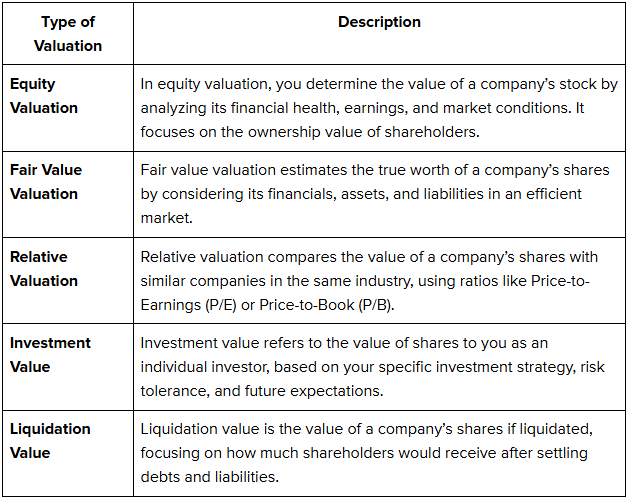
Now that you’re familiar with the different types of share valuation, let’s explore the key factors influencing the valuation of shares.
Factors Influencing the Valuation of Shares
Understanding the factors that influence the valuation of shares is crucial for making smart investment decisions. Here are the key elements you should consider:
Economic Conditions
The overall state of the economy impacts share prices. Factors like GDP growth, inflation rates, and employment levels can influence investor sentiment. A strong economy generally leads to higher share prices, while economic slowdowns may lower valuations.
Financial Performance of the Company
A company's financial health, including revenue, profit margins, and Earnings Per Share (EPS), is crucial in determining its share value. Companies with strong financial performance typically have higher valuations, while weak financial results can cause share prices to drop.
Risk Factors
Investors assess various risks, including business, financial, and market risks. Companies that are seen as high-risk may have lower valuations due to uncertainties about their future earnings.
Future Growth Prospects
The expected future performance of a company plays a significant role in its share valuation. Companies with strong growth potential or innovative products are valued higher because investors expect them to generate higher profits in the future.
With a clear grasp of the factors that affect share valuation, it’s now essential to understand how to pick the right method for your specific financial goals.
Key Factors to Consider When Choosing the Right Valuation Method
When valuing shares, choosing the right method is essential based on various factors. Here are some key things to consider that can help you make the best choice:
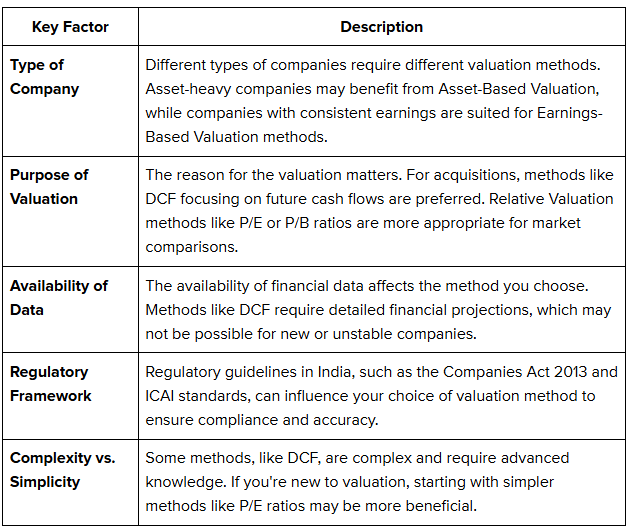
Conclusion
Valuation of shares is essential for understanding a company’s worth and making informed investment decisions. It helps investors determine the fair price of a share and ensures that they are not overpaying or underestimating the value of an asset.
The share valuation process involves combining different techniques and methods, such as DCF, market comparison, and asset-based approaches.
Understanding share valuation can enhance your decision-making process if you want to explore investment opportunities. Consider using platforms like Precize, which offers access to private equity and private credit investments, allowing you to diversify your portfolio with alternative asset-classes.
Start your journey with Precize, reserve your access, and explore investment opportunities that can enhance portfolio diversification to the next level!