
Companies often need funds to expand their business, manage operations, or take on new projects. One of the common ways they do this is by issuing debentures. These are widely used financial instruments that come with specific terms and conditions.
In this blog, you will learn about debentures, their features, different types, risks, and how they compare to bonds. Many people confuse debentures with bonds, but the two have differences. By the end of this blog, you will understand what debentures are and how they stand apart from bonds.
So keep scrolling to learn!
What are Debentures?
A debenture is a financial instrument used by companies to borrow money from the public for a fixed period at a predetermined interest rate. It is a type of long-term debt security that does not grant ownership rights but makes the holder a creditor to the company.
An Example of a Debenture
If a company wants to raise ₹100 crore for business expansion. Instead of taking a loan from a bank, it issues debentures to the public, offering a fixed interest rate. People who buy these debentures become creditors to the company and receive regular interest payments until the principal amount is repaid on maturity.
Now that you’re familiar with the basics of debentures, it’s time to explore the features that you should know about.
Features of Debentures
Knowing the features of debentures helps in understanding how they function in the financial market. Below are their main features:
Fixed Interest Payments
Companies issuing debentures pay a fixed interest rate at regular intervals, such as annually or semi-annually. This provides a predictable income stream and remains unaffected by stock market fluctuations.
Fixed Maturity Period
Every debenture has a predetermined maturity date when the principal amount is repaid to the holder. This provides clarity on the repayment timeline, whether short-term or long-term.
Transferability
Most debentures can be traded in the secondary market, allowing holders to sell them before maturity. This adds liquidity and provides flexibility in financial planning.
Credit Rating
Before issuing debentures, companies are usually evaluated by credit rating agencies. A higher credit rating indicates a lower risk, while a lower rating suggests a higher risk of default.
No Ownership Rights
Holding debentures makes you a creditor, not an owner of the company. Unlike shareholders, debenture holders do not have voting rights or any say in company decisions.
Having understood the features, let’s move on to explore the different types of debentures.
Types of Debentures
Different types of debentures serve different financial purposes. Below is a clear explanation of the main types:
Convertible Debentures
These debentures can be converted into equity shares of the issuing company after a specific period. The conversion terms are decided at the time of issuance, offering the possibility of both fixed-interest earnings and future equity ownership.
Non-Convertible Debentures
Unlike convertible debentures, these cannot be converted into equity shares.
Instead, they are redeemed at their face value upon maturity.
They usually come with higher interest rates to compensate for the lack of a conversion option.
Secured Debentures
Secured debentures are backed by the company’s assets, meaning if the company fails to repay, these assets can be used to recover the amount. This added security reduces the risk for debenture holders.
Unsecured Debentures
These debentures are not backed by any collateral and rely entirely on the issuing company’s financial strength. Since they carry higher risk, they often offer higher interest rates to attract buyers.
Redeemable Debentures
Redeemable debentures come with a fixed maturity date when the company repays the principal amount. They are commonly used for medium to long-term financing and follow a structured repayment schedule.
Perpetual Debentures
Also known as irredeemable debentures, these have no fixed maturity date.
The company continues to pay interest indefinitely, and the principal is repaid only if the company is liquidated or under specific conditions mentioned in the agreement.
Next, let’s discuss the potential debenture risks that you should be aware of.
Risks Associated with Debentures

Before dealing with debentures, it is important to know the risks involved. Here are the main risks:
Credit Risk
This risk arises if the company fails to pay interest or repay the principal. It is higher for unsecured debentures without asset backing. A lower credit rating means a higher chance of default.
Inflation Risk
Inflation reduces the value of money over time. If inflation is higher than the interest rate on your debenture, the real value of your returns will go down.
Liquidity Risk
Some debentures may not be easy to sell in the market. If there are no buyers, you may have to sell at a lower price or wait until maturity to get your money back.
Now that we’ve covered the risks associated with debentures, let’s take a look at how they compare to bonds.
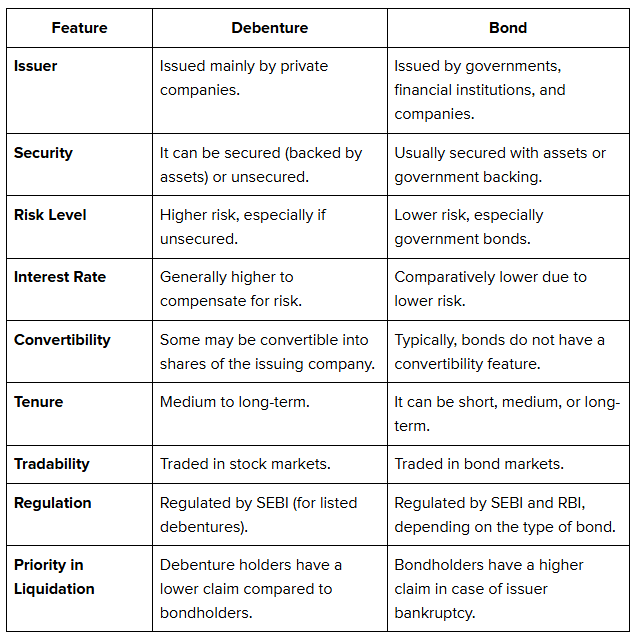
Difference Between Debenture and Bond
Companies and governments use debentures and bonds to raise funds, but they differ. The table below highlights the main difference:
Conclusion
In this blog, we’ve covered the essential aspects of debentures, including their types, features, and the differences between debentures and bonds. From understanding secured to learning about convertible types, you now have a clear overview of how debentures work in the financial market.
If you are looking for opportunities beyond traditional markets, Precize provides access to private equity and credit opportunities in India. With a low minimum investment of ₹10,000 and a focus on research-driven insights, Precize ensures a secure and seamless experience.
Reserve your access today to explore and diversify your portfolio!
Disclaimer
The information provided in this blog is for educational purposes only and is not intended to offer financial advice. The details shared regarding debentures, their types, features, and differences with bonds are based on general knowledge and may not apply to every individual or situation. It is important to conduct thorough research or consult a financial advisor before making any financial decisions.