When you think about ways companies or governments raise money, borrowing often comes to mind. This is where debt securities play a significant role in the financial world. Whether it’s a corporate bond or a government-issued debenture, debt securities are everywhere, even if they aren’t always obvious.
In this blog, we’ll explain everything you need to know about them. We’ll cover what debt securities mean, their key features, the benefits they offer, how they compare to equity securities, and the common risks involved.
So, let’s begin!
What does Debt Securities mean?
Debt securities are a way for companies, governments, or other organizations to borrow money from the public. When you buy one, you’re essentially lending money to the issuer for a set period. In return, they promise to pay back the money on a specific date, along with regular interest payments.
With that definition in mind, let’s take a closer look at the main features that define debt securities.
Primary Features of Debt Securities
Debt securities play an important role in the financial world, and understanding their key features can help you make sense of how they work. The following are the primary features of debt securities:
Issue Date
Debt securities are first issued to the public on a specific date. This marks the beginning of the period during which the holder can receive interest payments.
Issue Price
The price at which the debt security is initially sold can be at par (equal to its face value), at a discount, or at a premium.
Maturity Date
The maturity date is when the issuer must repay the holder the principal amount. Debt securities can have various maturities, from short-term (less than one year) to long-term (several decades).
Face Value
The face value, also known as par value, is the amount that the issuer agrees to repay the holder when the debt security reaches maturity. This value also serves as the basis for calculating interest payments.
Coupon Rate
This is the interest rate paid by the issuer to the holder, usually expressed as a percentage of the face value. It can be fixed or variable.
Interest Payments
These are the regular payments made to the holder, often semi-annually or annually, based on the coupon rate.
Yield to Maturity (YTM)
Yield to maturity is the total return expected on a debt security if it is held until maturity. This includes interest payments and any potential gains or losses if the security is bought at a price different from its face value.
Secured vs. Unsecured
Secured debt securities are backed by collateral, offering added protection for the holder. Unsecured securities are not backed by assets and depend on the issuer’s creditworthiness.
Seniority
This refers to the order in which debt holders are repaid in case the issuer goes into liquidation. Senior debt holders get paid first, followed by subordinated debt holders.
Call Option
A call option allows the issuer to repay the debt before the maturity date, often at a set price. This feature is typically used when interest rates fall.
Put Option
A put option gives the holder the right to ask for early repayment under certain conditions, offering more flexibility.
You now have a good grasp of debt securities and their features. Next, let’s explore the different types of debt securities to consider.
Types of Debt Securities
When you look into debt securities, you’ll come across various types, each with its own features and purposes. Here are the types of debt securities:
Bonds: Bonds are one of the most widely known forms of debt securities. Bonds typically offer a fixed return and come in different forms:
Government Bonds: Issued by national or state governments, these are considered safe investments.
Corporate Bonds: Issued by companies, they come with higher risk compared to government bonds.
Convertible Bonds: These bonds can be converted into shares of the issuing company.
Zero-Coupon Bonds: Sold at a discount and redeemed at face value, these do not offer periodic interest payments.
Inflation-Linked Bonds: The returns on these bonds are adjusted based on inflation rates.
Debentures: Dare unsecured debt instruments issued by companies. They depend on the issuer’s creditworthiness and lack collateral backing.
Commercial Papers (CPs): Commercial papers are short-term debt instruments issued by companies to raise funds, with maturities ranging from 7 days to one year.
Certificates of Deposit (CDs): Offered by banks, these are time-bound deposits with fixed interest rates and maturity periods ranging from one to three years.
Treasury Bills (T-Bills): Treasury bills are short-term government securities with maturities of up to 364 days. They are considered to be very low-risk.
National Savings Certificates (NSCs): National savings certificates are long-term government-issued savings certificates that offer fixed returns.
Fixed Deposits: Offered by banks and post offices, fixed deposits provide a guaranteed return over a predetermined period.
Promissory Notes: These are written promises to repay a debt, commonly used in business transactions.
With the types of debt securities in mind, it’s time to understand the key benefits they bring to the table.
Investment Benefits of Debt Securities

When considering debt securities, there are several benefits that make them a valuable part of a financial strategy:
Consistent Stability and Lower Volatility
Debt securities, especially those issued by governments, are recognized for their stability. They are generally less subject to market fluctuations compared to equities, making them a more stable option for those seeking steady returns.
Steady Interest Payments
A notable feature of debt securities is the regular interest payments, which can be monthly, quarterly, or annually. This provides a reliable source of income, which is not guaranteed with equity-based assets.
Risk Diversification
Using debt securities in a financial portfolio can help mitigate risk. They tend to balance the riskier nature of equity investments, leading to a more diversified and stable overall portfolio.
Liquidity Options
Many debt securities can be sold before maturity, offering flexibility when access to funds is needed. This liquidity is particularly useful for managing unexpected cash flow requirements.
Lower Risk Profile
Although all investments carry some degree of risk, debt securities typically come with lower risk compared to equities. For instance, government-backed securities are often seen as low-risk or even risk-free.
With the investment benefits of debt securities in mind, it's important to understand how they compare to equity securities.
Comparison of Debt Securities With Equity Securities
Knowing the differences between debt and equity securities helps you get a better understanding of how each plays a role in financial planning. Here is a comparison table to help you grasp their distinct aspects:
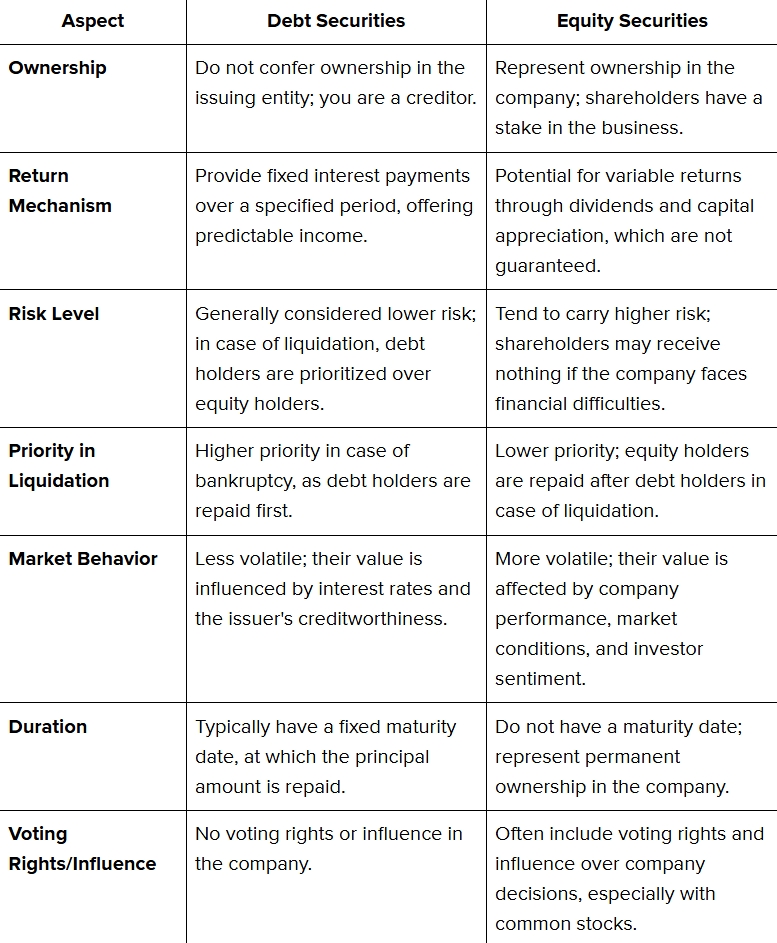
Now that you have a clear comparison between debt and equity securities, let’s take a look at the potential risks associated with debt securities.
Common Risks Involved in Debt Securities
When dealing with debt securities, it’s important to be aware of the risks that could impact your returns. Here are some of the common risks associated with them:
Credit Risk (Default Risk)
This risk arises when the issuer of a debt security fails to make timely payments of interest or principal. Corporate bonds carry a higher credit risk compared to government securities.
Interest Rate Risk
Fluctuations in market interest rates can impact the value of debt securities. When interest rates rise, the value of existing bonds with lower interest rates tends to decline.
Liquidity Risk
Liquidity risk occurs when you're unable to sell your debt securities quickly at a reasonable price due to low market demand.
Reinvestment Risk
This risk arises when interest rates decline, making it harder to reinvest the interest payments from your securities at comparable rates.
Inflation Risk
Rising inflation can erode the purchasing power of your returns, especially if the bond yield does not keep up with inflation.
Counterparty Risk
This is the risk that the other party in a transaction fails to meet their obligations, affecting your financial position.
Sovereign Risk (Country Risk)
This risk applies to government-issued securities. It arises when a country experiences economic or political instability that affects its ability to repay debts.
Conclusion
As we’ve discussed throughout this blog, debt securities offer a reliable and well-defined investment option. Their features, such as fixed returns and maturity dates, make them suitable for specific financial goals and objectives. They also play a crucial role in portfolio diversification, helping manage risk while providing a steady income stream.
If you’re looking to explore alternative investment opportunities in India, Precize offers access to private equity and private credit opportunities. The platform allows you to view the past price performance of unlisted companies and stay informed about the latest news and market trends.
You can reserve access and diversify your portfolio with Precize.
Disclaimer
The information provided in this blog is for educational purposes only and should not be considered financial advice. The content aims to help you understand the features and types of debt securities, but individual financial decisions should be based on personal circumstances and goals. Please consult with a financial advisor or expert before making any financial decisions.