Every financial transaction you make, whether earning income, purchasing goods, or availing services, comes with a tax implication. These taxes impact individuals, businesses, and the economy as a whole.
Understanding Direct and Indirect Taxes is essential for financial planning and compliance, as they form the backbone of India’s taxation system.
This blog will cover everything related to Direct and Indirect Tax. We will discuss what direct tax is, the types of direct taxes, and their benefits and disadvantages. Similarly, we will cover what indirect tax is, its various types, and the advantages and disadvantages of indirect taxes. Also, we will explain the differences between direct and indirect taxes to provide a clear comparison.
Let’s get started!
What is Direct Tax?
A direct tax is a tax that individuals and businesses pay directly to the government. It is applied to income, profits, or assets and cannot be transferred to another person. The amount depends on financial factors such as earnings or property value.
Now that you know what direct tax is, let’s look at its different types.
Types of Direct Taxes
The main types of direct taxes in India include:
Income Tax: Tax on the income of individuals, Hindu Undivided Families (HUFs), and businesses based on government-defined slabs.
Corporate Tax: Tax on the net profits of companies operating in India, with rates differing for domestic and foreign businesses.
Capital Gains Tax: Tax on profits from selling assets like stocks, property, or mutual funds. Classified as:
Securities Transaction Tax (STT): Tax on the buying and selling of securities, including shares and mutual funds, collected at the time of the transaction.
Property Tax: Tax paid by property owners based on the value of their land or building, collected by local municipal authorities.
With these types of direct taxes in place, now, let’s go over their advantages.
Advantages of Direct Taxes
Direct taxes have several advantages in the taxation system. Some of them include:
Fair Distribution of Tax Burden
Taxes are applied based on income levels, ensuring that higher-income groups contribute more while lower-income groups have reduced tax obligations or exemptions.
Predictable Tax Collection
Fixed tax rules provide clarity for both taxpayers and the government, ensuring a stable revenue flow and reducing administrative challenges.
Cost-Effective Collection Process
Taxes like income tax are deducted at the source, reducing collection costs and simplifying the administrative process.
Flexible Revenue Adjustment
Tax rates can be modified when required, allowing the government to manage financial requirements efficiently.
Reliable Government Revenue
A steady source of income enables the government to allocate funds for public infrastructure, welfare programs, and essential services.
Despite their advantages, direct taxes have disadvantages that can create financial and administrative challenges. Let’s explore that next.
Disadvantages of Direct Taxes

Certain aspects of direct taxes create difficulties for taxpayers and the economy. These include:
Financial Burden
Taxes such as income tax are paid in lump sums or installments, which can affect cash flow, particularly for individuals with lower disposable income.
Complex Compliance Process
Filing taxes requires documentation, calculations, and adherence to regulations, making the process time-consuming and sometimes requiring professional assistance.
Possibility of Tax Evasion
Despite regulations, some individuals and businesses find ways to underreport income or manipulate financial records to reduce tax liabilities.
Direct Impact on Taxpayers
Since direct taxes are paid separately and not included in product prices, they are more noticeable, leading to resistance in compliance.
While direct taxes have their challenges, they are just one part of the taxation system. Now, let’s look at indirect taxes.
What is Indirect Tax?
Indirect tax is a tax imposed on goods and services instead of income or profits. It is collected by intermediaries, such as sellers or manufacturers, and paid to the government. The tax amount is included in the price of goods or services, making the consumer responsible for the final payment.
For example, if a restaurant bill is ₹3,000 and GST is 5%, the total payable amount becomes ₹3,150. The ₹150 GST is collected by the restaurant and remitted to the government.
You pay indirect taxes regularly, but do you know the different types? Let’s take a look.
Types of Indirect Taxes
Various types of indirect taxes are applied to goods and services in India.
Goods and Services Tax (GST): It was introduced on July 1, 2017, replacing multiple indirect taxes such as VAT, excise duty, and service tax.
It is applied at various stages of production and distribution.
GST is divided into Central GST (CGST), State GST (SGST), and Integrated GST (IGST) for interstate transactions.
Customs Duty: This tax is charged on goods imported into India. The applicable rate depends on the type of goods. It is collected at ports of entry, including airports and seaports.
Excise Duty: It is applied to the manufacture of certain goods within India. While GST has replaced most excise duties, they continue for specific items such as alcohol and petroleum products.
Stamp Duty: It is imposed on legal documents related to property transactions and agreements. State governments collect it, and the rate varies based on location and transaction type.
Securities Transaction Tax (STT): This tax applies to buying and selling securities on India’s stock exchanges. It is collected at the time of transaction execution.
With the different types of indirect taxes covered, let’s explore the advantages they offer.
Advantages of Indirect Taxes
Indirect taxes have several benefits that impact both taxpayers and the economy.
Broad Contribution
Indirect taxes apply to all consumers, ensuring widespread tax collection. Tourists, residents, and individuals across economic groups contribute when purchasing goods and services.
Convenience
These taxes are included in the price of goods and services, eliminating the need for separate payments. Collection at the point of sale simplifies compliance for businesses.
Lower Tax Evasion
Since these taxes are built into the price of goods and services, they are automatically collected, making tax evasion less likely.
Consumption-Based Contribution
The amount of tax paid depends on spending. Those purchasing essential goods pay lower taxes, while those consuming luxury items pay more.
Despite the advantages, indirect taxes have some disadvantages.
Disadvantages of Indirect Taxes
Indirect taxes have certain disadvantages that affect consumers and businesses. Here are the four disadvantages of indirect taxes:
Same Tax for Everyone
These taxes do not change based on income, which means everyone pays the same rate for a product, which can be harder on lower-income groups.
Increase in Prices
Since these taxes are added to the cost of goods and services, they can make products more expensive for consumers.
Uncertain Revenue
The amount of tax collected depends on consumer spending. If people reduce purchases due to high prices, tax collection may drop.
Higher Costs for Businesses
Increased taxes on raw materials and production expenses can raise manufacturing costs, affecting business growth.
Now, let’s put direct and indirect taxes side by side to see how they differ.
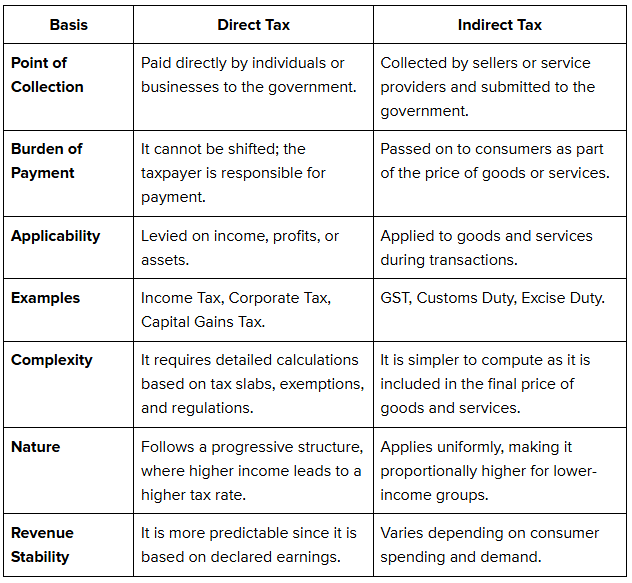
Differences Between Direct and Indirect Taxes
Direct and indirect taxes are structured differently regarding how they are collected and who bears the financial burden. The table below highlights the distinctions between them:
Conclusion
By understanding the aspects of direct and indirect taxes, including their types, advantages, disadvantages, and differences, it is clear that both play a significant role in revenue collection and economic stability. While direct taxes are linked to income and profits, indirect taxes are applied to goods and services, impacting every consumer.
For those seeking alternative investment opportunities, Precize provides access to private equity and private credit opportunities, reserve access today to build a diversified portfolio.
Disclaimer
The information provided in this blog is for general knowledge purposes only and should not be considered tax or financial advice. Tax laws and regulations are subject to change, and their application may vary based on individual circumstances. It is advisable to consult a qualified tax professional or financial advisor for specific guidance related to direct and indirect taxes.