
In a rapidly growing economy like India, where GDP is expected to grow between 6.3% and 6.8% in FY26, understanding the different types of economic systems, like a market economy, that shape its growth is crucial.
In this blog, we’ll explain the market economy, and its characteristics, and discuss examples of market economies. Also, you’ll see some of the disadvantages of this system. Finally, we’ll compare a market economy with other systems. By the end of this blog, you’ll gain valuable insights into the market economy.
Let’s explore!
What is a Market Economy?
A market economy is a system where economic decisions, such as what to produce, how to produce, and for whom to produce, are driven by supply and demand. In this system, businesses and consumers make choices based on their needs and preferences, with minimal government intervention.
Now that you understand what a market economy is, let’s take a closer look at the characteristics that make it work.
Characteristics of a Market Economy

A market economy is defined by several key characteristics that shape its structure and operations:
Private Ownership
In a market economy, individuals or private businesses own the resources, such as land, labor, and capital. They control what is produced and how it is used.
Supply and Demand
The prices of goods and services are set by supply and demand. Producers and consumers interact in the market, and their decisions help determine the price of products.
Freedom of Choice
Both producers and consumers have the freedom to make their own choices. Producers decide what to offer in the market, and consumers choose what to purchase based on their needs and preferences.
Competition
Businesses compete to attract customers, leading to better quality, innovation, and competitive pricing in the market. This benefits consumers by offering more options.
Limited Government Role
The government’s role is minimal in a market economy. It mainly ensures fair competition, enforces laws, and helps maintain overall market stability.
Self-Regulation
The market largely runs through voluntary exchanges between buyers and sellers. This interaction helps balance supply and demand naturally.
Profit Motivation
Businesses are driven by the goal of making profits. They do this by efficiently meeting consumer demands, which boosts productivity and encourages innovation.
With the characteristics of a market economy in mind, let’s now explore the market economy examples.
Examples of Market Economy
A market economy operates on the principles of supply and demand, with minimal government involvement. Here are four examples of countries that follow this system:
India
India is mainly a mixed economy, with market principles influencing sectors like technology, retail, and agriculture, especially after its economic liberalization in 1991.
However, the government continues to regulate essential sectors like public services and agriculture to maintain stability.
Japan
Japan follows a market-oriented economy where private businesses largely control production and pricing, guided by consumer demand.
United States
While the U.S. is often considered a mixed economy, it strongly follows market economy principles.
Supply and demand drive production and pricing, but the government plays a key role in regulating sectors like healthcare, and finance, and providing social welfare programs.
United Kingdom
The UK operates a social market economy but is classified as a mixed economy due to government involvement in areas like healthcare, education, and public infrastructure, balancing private market forces with social welfare.
While examples of market economies help us understand how they operate, it’s crucial to also look at the disadvantages they might bring.
Disadvantages of a Market Economy
A market economy has several disadvantages that can affect society and individuals:
Income Inequality
Wealth tends to concentrate among the rich, creating a large gap between them and the poor, with limited opportunities for those at the lower end.
Environmental Damage
Profit-driven economic activities may neglect environmental protection, leading to pollution and depletion of natural resources.
Neglect of Public Goods
Services like public transportation and defense may be underfunded since they don’t generate profits, requiring government intervention.
Overproduction of Harmful Goods
Products like tobacco and junk food may be overproduced due to their profitability, despite their negative effects on health.
Market Failures
Market economies can fail to allocate resources efficiently, with monopolies, incomplete information, and externalities disrupting supply and demand.
Poor Working Conditions
Without government regulation, businesses may exploit workers with low wages, unsafe environments, and long hours to maximize profits.
With the disadvantages in mind, it’s time to compare the market economy to other systems to understand its unique features better.
Market Economy Comparison with Other Economic Systems
To better understand how a market economy differs from other economic systems, below is a comparison table of key features. 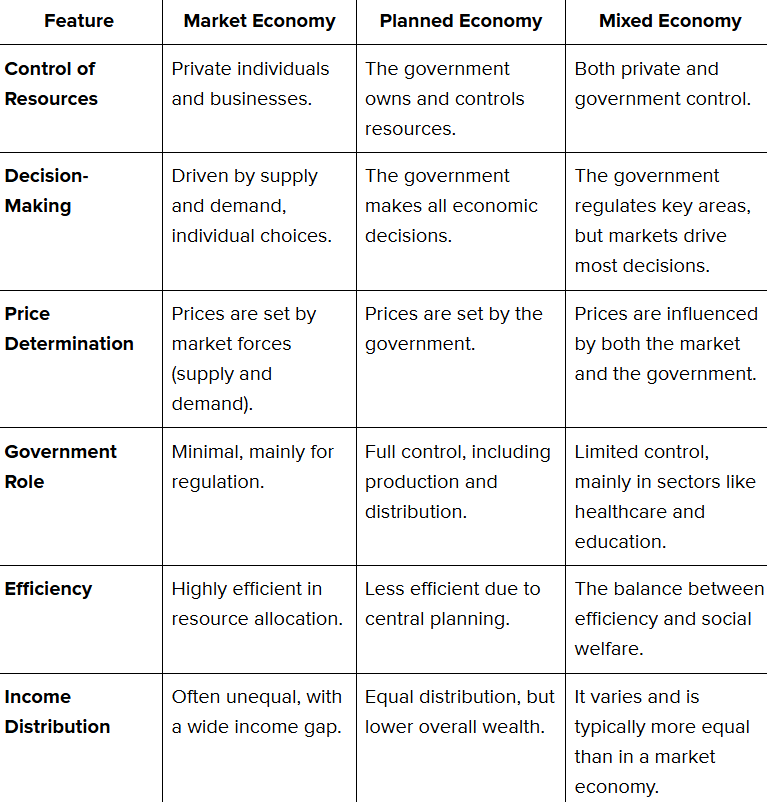
Conclusion
As we’ve explained throughout this blog, understanding what is a market economy is essential to grasp how economies function with minimal government interference. In a market economy, supply and demand dictate production, pricing, and resource allocation, allowing businesses and consumers to make decisions based on market conditions.
If you’re interested in expanding your investment opportunities, platforms like Precize allow you to engage with leading private companies. You can buy and sell unlisted shares and pre-IPO shares, while also exploring global trade finance opportunities to diversify your portfolio with alternative fixed-income opportunities.
Reserve access and take the first step today to diversify your portfolio!
Disclaimer
The content provided in this blog is for informational purposes only and does not constitute financial advice. The information shared about what is a market economy is intended to enhance understanding of economic systems and should not be used as a basis for making any financial decisions. Always consult with a qualified financial advisor before making any decisions regarding your financial portfolio.