If you’re exploring startup funding or investing in pre-IPO companies, one document you’ll often hear about is the term sheet. While it might seem like legal jargon at first, the term sheet plays a vital role in early-stage funding, venture capital deals, and pre-IPO investments.
In this blog, we’ll break down what a term sheet is, its key components, and why it matters for both founders and investors.
What is a Term Sheet?
A term sheet is a simple document that outlines the main terms of a potential investment. Think of it like a summary or a rough draft that both the startup and investor agree on before signing any final legal paperwork. It shows what each side wants and agrees on—like how much money is being invested, how much of the company the investor will own, and what rights each party will have.
While most of the document isn’t legally binding (except for parts like confidentiality), it’s a helpful way to make sure everyone is on the same page before moving forward.
Why is a Term Sheet Important?
In startup and pre-IPO investments, a term sheet helps in:
Clarifying Expectations: It ensures that both founders and investors are on the same page about the valuation, ownership structure, and rights.
Speeding Up the Process: With clear terms laid out, legal documentation becomes easier and faster.
Avoiding Future Disputes: Documenting critical terms early on reduces ambiguity and future conflicts.
Protecting Interests: It offers protective provisions to investors while providing founders with a roadmap for capital raise.
Key Components of a Term Sheet
Understanding a term sheet means understanding its key elements. Here's what you typically find in one:
1. Valuation
This is perhaps the most important part. It specifies:
Pre-money valuation: The company’s valuation before a new investment.
Post-money valuation: Valuation after the investment is added.
2. Investment Amount
This section specifies how much capital the investor is willing to invest in the company in exchange for equity.
3. Equity Stake / Ownership
Based on the valuation and investment amount, the investor receives a specific percentage of ownership in the company.
4. Type of Security
It defines the kind of shares or instruments being issued:
Common shares
Preferred shares
Convertible notes
SAFE (Simple Agreement for Future Equity)
5. Liquidation Preference
This clause determines how proceeds are distributed if the company is sold or liquidated. For example, investors may be entitled to get their capital back before any distribution to founders.
6. Board Composition
Specifies how many board seats investors will have and how much control they can exert over company decisions.
7. Anti-Dilution Protection
To protect early investors from dilution if the company raises funds in the future at a lower valuation.
8. Voting Rights
Outlines the investor's voting powers on company matters such as future fundraising, acquisition, or structural changes.
9. Exit Rights
Details how and when investors can exit via IPO, sale, buyback, or secondary sales.
10. Exclusivity and Confidentiality
This legally binding section ensures that the startup won’t negotiate with other investors during the agreed period and that terms remain confidential.
Term Sheet in Startup Funding
A term sheet is a gateway to institutional or angel investment for startups, especially during seed or Series A rounds. It allows founders to understand what they’re giving up in exchange for capital. A favourable term sheet can also set the tone for future funding rounds and company valuation.
Investors, particularly venture capital firms, use term sheets to standardise deals, reduce negotiation time, and mitigate risks.
Term Sheet in Pre-IPO Investments
When investing in companies at the pre-IPO stage, a term sheet is critical because:
These companies are more mature than startups, and deal sizes are often larger.
Pre-IPO shares are typically sold at negotiated prices before the public listing, making clarity on terms essential.
Liquidity events (IPO, acquisition) are nearer, so exit clauses become even more relevant.
Secondary transactions (buying from existing shareholders) also require term sheets to confirm terms and transfer rights.
Term Sheet vs Shareholder Agreement
Many people confuse a term sheet with a shareholder or investment agreement. Here's a quick comparison to highlight the key differences: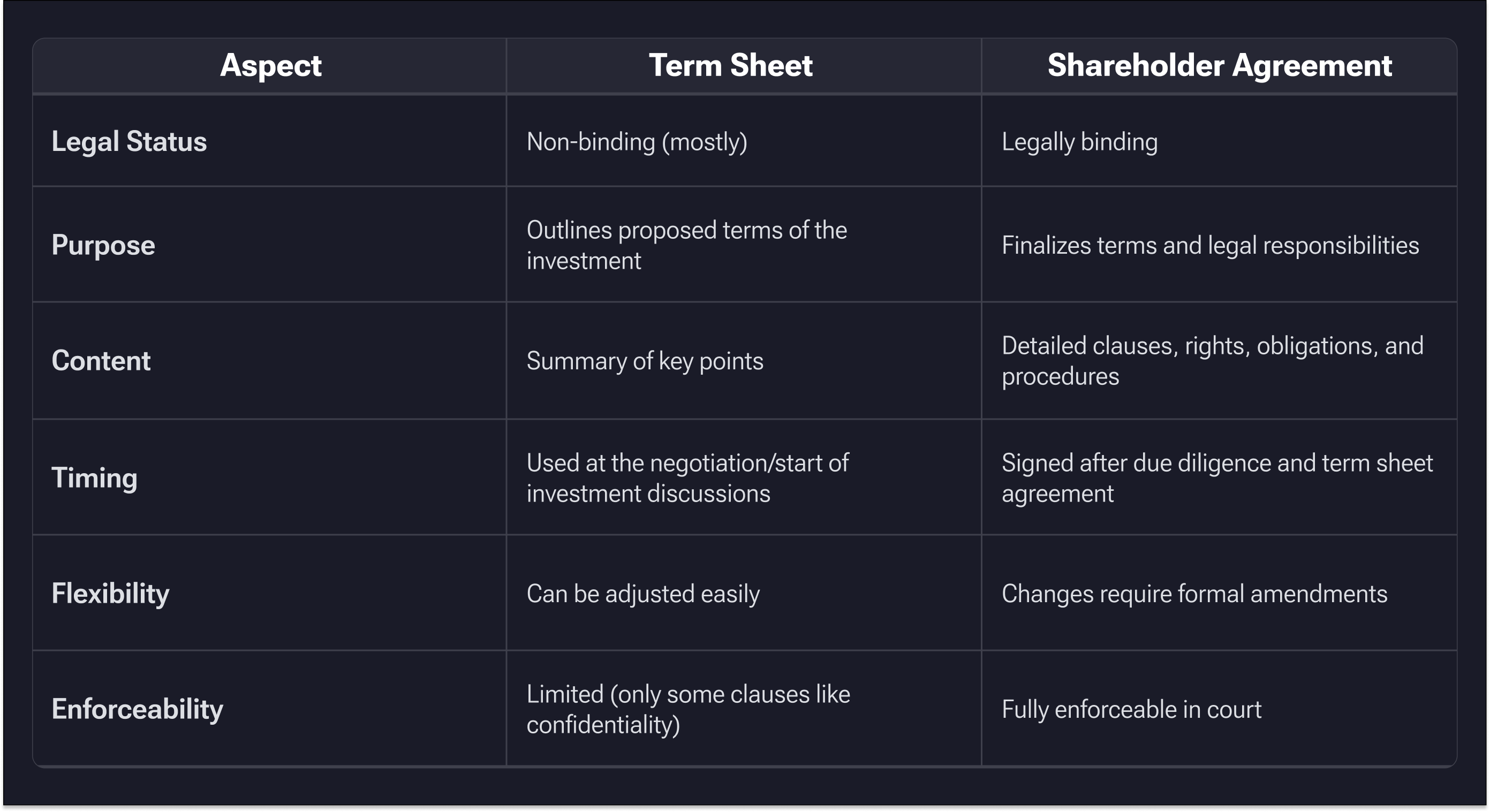
Conclusion
In the dynamic world of startups and pre-IPO investing, a term sheet is more than just paperwork it’s the foundation of trust, clarity, and partnership between the company and its investors. Whether you're raising your first round or investing in a soon-to-be-listed unicorn, understanding the term sheet is crucial to making informed, strategic decisions.
If you're interested in exploring alternative investment opportunities, Precize offers a platform that provides access to pre-IPO shares and global trade finance opportunities. With a minimum investment of ₹10,000, these investment options become accessible to a wide range of investors. Precize emphasizes security and provides research-driven insights to help you make informed investment decisions.
So, take the first step in diversifying your portfolio by Reserving your access on Precize.
(Disclaimer: This blog is for informational purposes only and does not constitute financial, legal, or investment advice. Investing in startups, pre-IPO companies, or alternative assets involves risk, including the potential loss of capital. Readers are advised to conduct their own research and consult with a licensed financial advisor or legal expert before making any investment decisions. Precize does not guarantee any specific investment outcome and is not responsible for any losses incurred from reliance on the information provided in this blog.)